
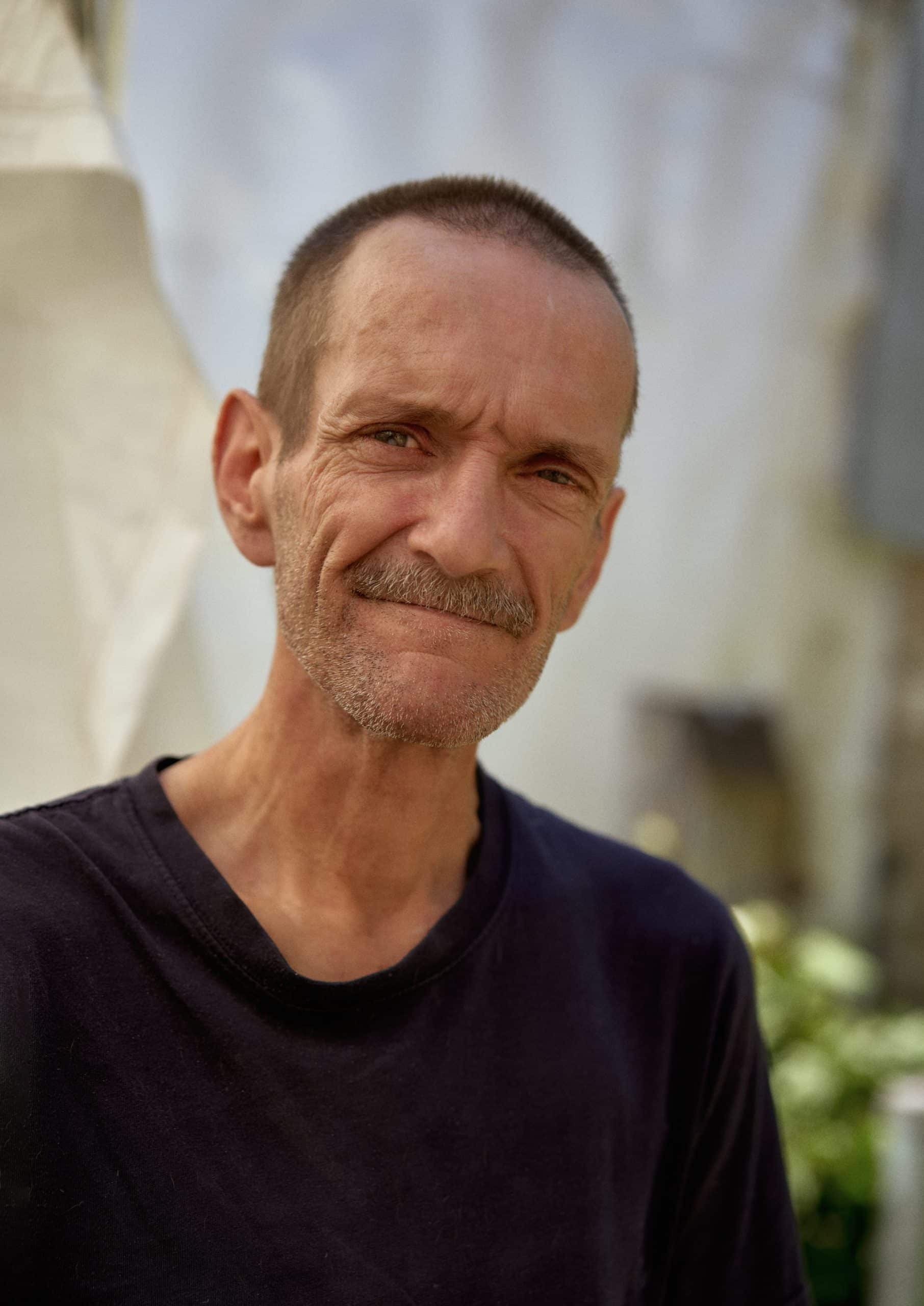
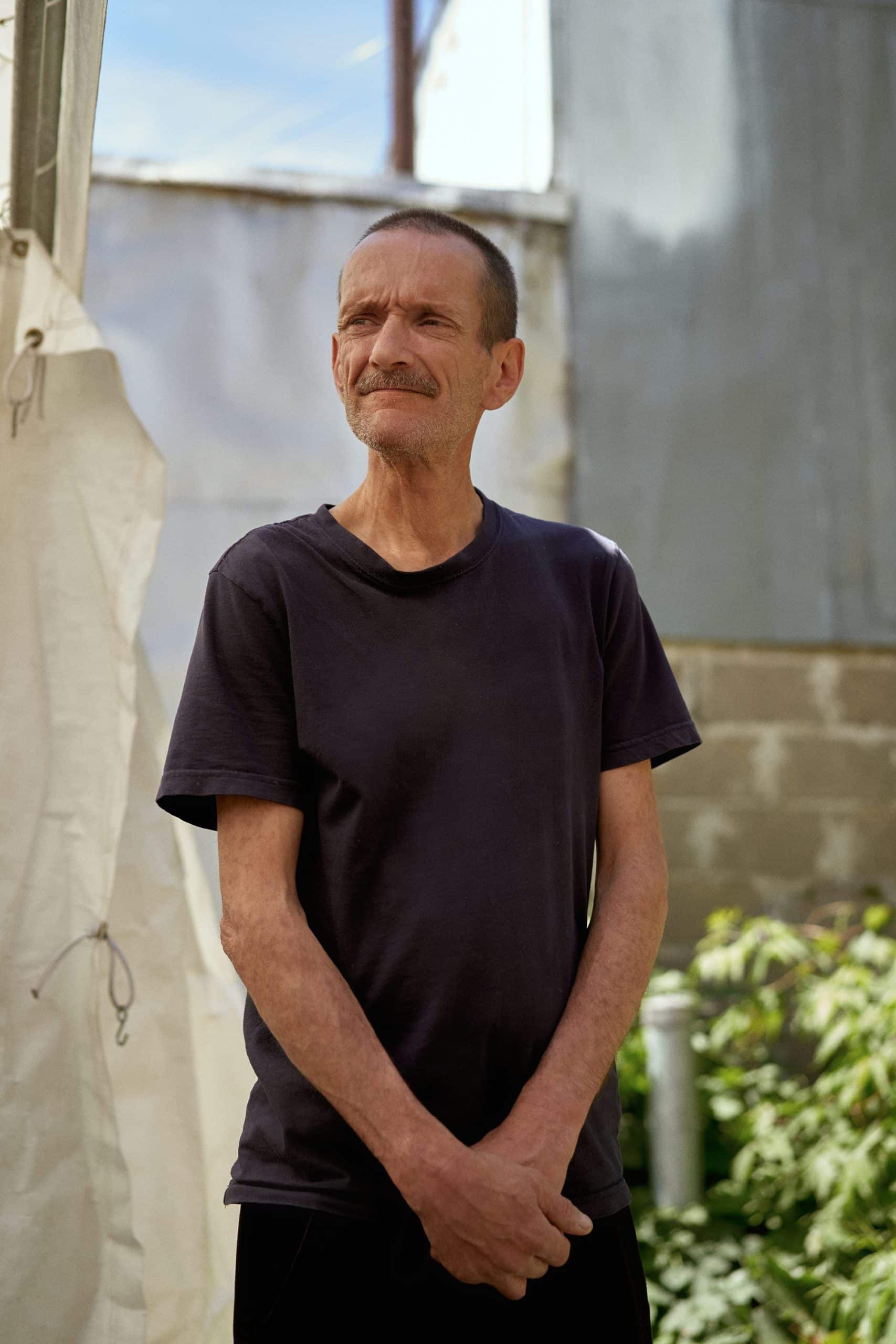
“This won’t be my first front page,” Sylvain proudly declares as his portrait is being taken.
He is referring to the time an article featuring him made the front page of local newspapers. The article, titled A Wave of Generosity in Saint-Henri, described how Sylvain ended up on the street after losing his home and all his belongings in the fire that destroyed his apartment building.
“Bad luck.”
It also recounted how the residents of his neighbourhood rallied around him to offer support.
What the article didn’t mention was that nearly five years later, despite this community support, Sylvain would still be on the margins of a system that seems to have forgotten him. One of the biggest obstacles in this reality is access to health. Especially for Sylvain, who, due to illness, requires close monitoring. But it’s neither technicalities nor a lack of resources that make this so difficult for him. It’s mostly the stigma. The way others look at him.
“Hospitals change when you’re in a situation like mine. You can feel that people see you as a nuisance. You end up not wanting to go anymore.”
That doesn’t mean he’s given up, though.
“It’s too easy to just let yourself go. You have to find a way to help yourself. Then you realize that other people are ready to help you too. I don’t ask for anything, but it’s amazing what I receive. People’s kindness blows me away.” He pauses for a second. “Well, not that much, really—I’m actually a pretty nice guy.”
He tells us that it was this human solidarity that helped him get back on his feet.
“I kept telling myself that if that person had the heart to give me money, there’s no way I was going to use it for nonsense.”
One of the people who showed Sylvain this kindness was Valérie. No last name, no professional title, just Valérie. An outreach worker who became a friend. “An angel,” he specifies. It was through Valérie that Sylvain learned about Médecins du Monde’s mobile clinic. And it was through Médecins du Monde’s network that he was able to help others in turn.
“I had a friend who came to live with me for a while after her own bad luck. She had a great job before, working in aviation. But pills are stronger than everything. One day, I saw her go over the edge. I didn’t know what to do. I called Valérie. She called some people. My friend was admitted to the hospital, and everyone took care of her. Not long ago, I ran into her again. She’s doing well; she’s back. But I can say without a doubt that if I hadn’t called Valérie, my friend would be dead today.”
Without even pausing, he moves on to another topic, leaving us to guess that he’s seen other stories like this. We talk about the lab scientist he sometimes has lunch with. We talk about the people he meets, the sense of community in his neighbourhood, and the $600 running shoes he was once given. “You could twist them any way you wanted, and they’d always bounce back!” We talk about the worsening pollution and the things that are getting better.
“Anyway, it was really great talking to you,” Sylvain suddenly says, blowing us a kiss before rushing off on his scooter, flip phone to his ear. He’s expected somewhere. And he has to go feed his dog.
“His name’s Magnum. Magnum and I take care of each other.”
We would like to pay tribute to Sylvain and offer our condolences to his loved ones.
Thank you to our partner!
