On the street

Clinic
mobile.

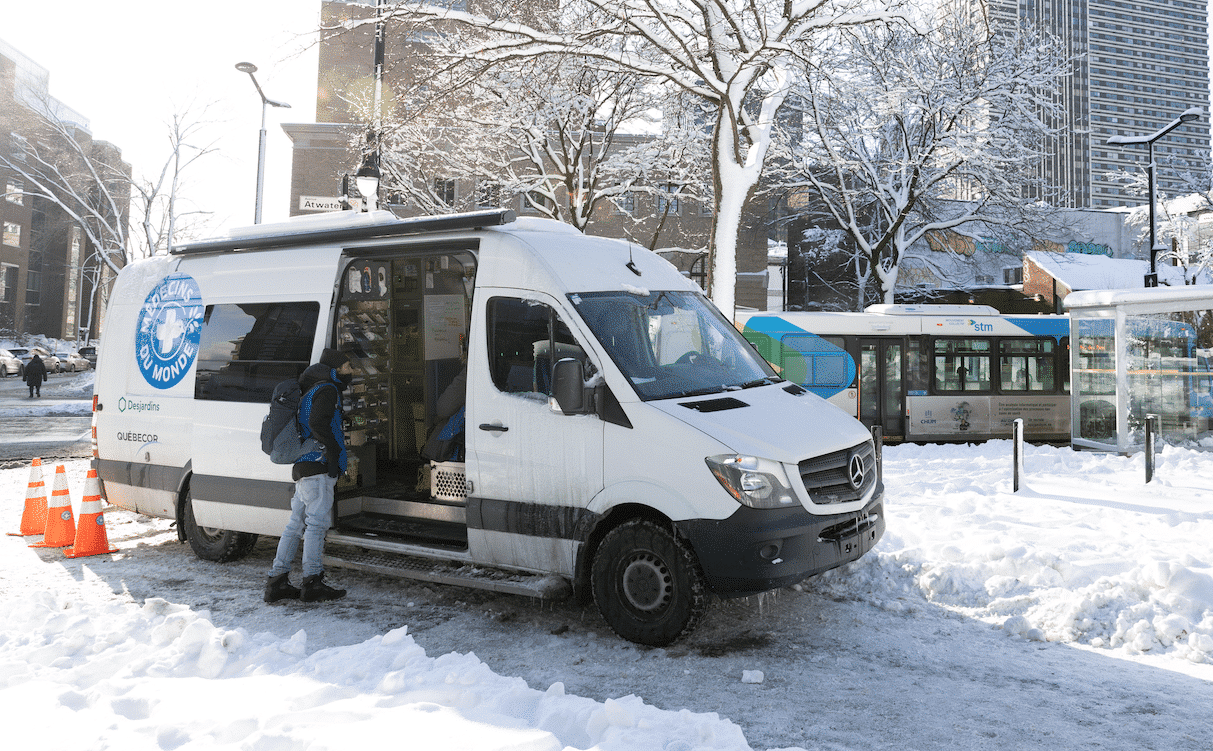
Since 2014, aboard the Mobile Clinic, outreach nurses, accompanied by a volunteer, meet with people experiencing homelessness on the streets, in parks and in shelters.

People experiencing homelessness Risk and harm reduction Primary care
Practical information
In case of Mobile Clinic absence
514-501-3411
Outings may be shortened depending on the level of attendance. Please arrive at the beginning of the outing.
Questions?
info@medecinsdumonde.ca.
Service in French, English, Spanish
6235 rue Saint-Hubert, Montréal
Care offered at the clinic

Primary care offered aboard the Mobile Clinic

By nurses, peer support workers in harm reduction and volunteer doctors
Vaccination

Screening for sexually transmitted and blood borne infections (STBBIs)

Wound care

Advice and distribution of harm reduction supplies – substance use component

Our mission

Precariousness should never be an obstacle to care.

Aboard the Mobile Clinic, outreach nurses, accompanied by a volunteer, meet with people experiencing homelessness on the streets, in parks and in shelters. They provide care and listen without judgment, away from prying eyes and in complete safety.

Referral to health professionals or community organizations

The Clinic also allows them to create a connection with these individuals, sometimes struggling with mental health or substance use issues, and to refer them to community organizations, doctors and health professionals with whom they can develop a trusting relationship. This approach helps build a bridge between these individuals and the public health system.

Doctors of the World Canada is committed to fighting frameworks that stigmatize and criminalize excluded individuals, so they can fully exercise their fundamental rights and equitably access public health and social services systems. Our fight: Precariousness and exclusion
FAQ

Frequently asked questions

Some situations do not exactly match the criteria, but we may still be able to help. Select your situation.

Our services are for:
Indigenous people in urban areas;
Sex workers;
Men who have sex with men (MSM);
People identifying as part of an LGBTQ2S+ group;
People who use injection and inhalation drugs (PWUD);
Etc.
The Mobile Clinic’s intervention neighbourhoods are determined based on the needs of the people targeted by our interventions and the degree of accessibility to the health system. Doctors of the World always collaborates with community organizations already established in the neighbourhoods where clinical outings take place to properly identify the needs of the targeted population. And since each neighbourhood has its own unique identity, our nurses work alongside street-based outreach workers to reach people directly in the environments they frequent, facilitate their access to health care, and ensure an intervention better adapted to the needs identified by these individuals. The contribution of our community partners and volunteers is essential to our intervention model.
Contact us directly

Contact us directly

The clinic line is open Monday to Friday. We respond in French, English and Spanish. If the line is busy, leave a message — we’ll call back the same day.

Partners

They make our mission possible

Thank you to our financial partners.

The rest of the local program

Three other services by Médecins du Monde Canada in Montreal

Service · Itinérance

Clinique mobile

Soins infirmiers gratuits, directement dans la rue.

Service · Itinérance

Soutien psychologique

Du soutien psychologique aux personnes en situation précaire.

Service · Autochtone

Clinique autochtone

Accompagnement culturellement sécurisant en santé.

For professionals

Are you a social worker or health professional?

Here are resources to better support persons without status — community organizations, social workers, clinics.

Fiche d’information clinique (FR · EN · ES)
Critères d’admissibilité — document imprimable
Formation : accès aux soins pour migrants précaires
Three ways to meet us

Two fixed clinics and the mobile clinic

No appointment required for the fixed clinics. Show up during opening hours.

MdM Mobile Clinic
Cabot Square & shelters — variable schedule, depending on rounds.
Clinique fixe Sans rendez-vous

Au PAQ

199 rue de la Gauchetière Est · Projets Autochtones du Québec

Lundi 10h – 15h
Mercredi 10h – 15h
Jeudi 10h – 15h
Mar, ven, week-end Fermé
Clinique fixe Sans rendez-vous

Au CAAM

2007 boul. Saint-Laurent · Centre d’amitié autochtone de Montréal

Lundi 10h – 15h
Mardi 10h – 15h
Mercredi 10h – 15h
Jeudi au dimanche Fermé
Book an appointment

Two ways to get a consultation

In both cases, an assessment at triage is conducted before the medical consultation.

Rendez-vous pour le mercredi
Lundi · 17h00 – 20h00
514 281-8998 · Message vocal possible, rappel en soirée
Vous recevez un rendez-vous pour le mercredi suivant.
Consultation le jour même
Jeudi · 9h30 – 12h00
6235 rue Saint-Hubert · Arrivez tôt, places limitées
Consultation le jour même si des places sont disponibles.
Eligibility criteria

Is this clinic right for you?

The clinic welcomes persons who meet all the following criteria. If you are unsure, show up — triage assesses complex situations on site.

Required

Sans couverture médicale

Aucun accès à la RAMQ, au PFSI (Programme fédéral de santé intérimaire), ni à une assurance privée.

Required

Situation financière précaire

Impossibilité financière d’accéder à une clinique privée sans rendez-vous acceptant les patient·e·s sans RAMQ.

Required

Sans statut ou statut temporaire

Sans papiers, permis temporaire, attente de résidence permanente, ou autre statut précaire.

Required

Établi·e au Québec

Réside au Québec de façon durable — pas en visite temporaire ou en transit. Adulte (18 ans et plus).

Out of scope

Demandeurs d’asile

Ils ont accès au PFSI qui couvre leurs soins.

Out of scope

Enfants et visiteurs

Les enfants ont légalement droit à la RAMQ. Les touristes ou visiteurs de passage ne sont pas dans notre mandat.

Ensure your situation matches our eligibility criteria. If in doubt, we invite you to review the criteria or contact us directly. Our team remains available to answer your questions and support you.

Training · CHUM

Training care teams on migrant health

In partnership with the Centre hospitalier de l’Université de Montréal (CHUM), MdM has developed a training program that enables health professionals to understand the service, telemedicine, and the support of migrants with precarious status.