
What is the humanitarian situation in Gaza and the West Bank?
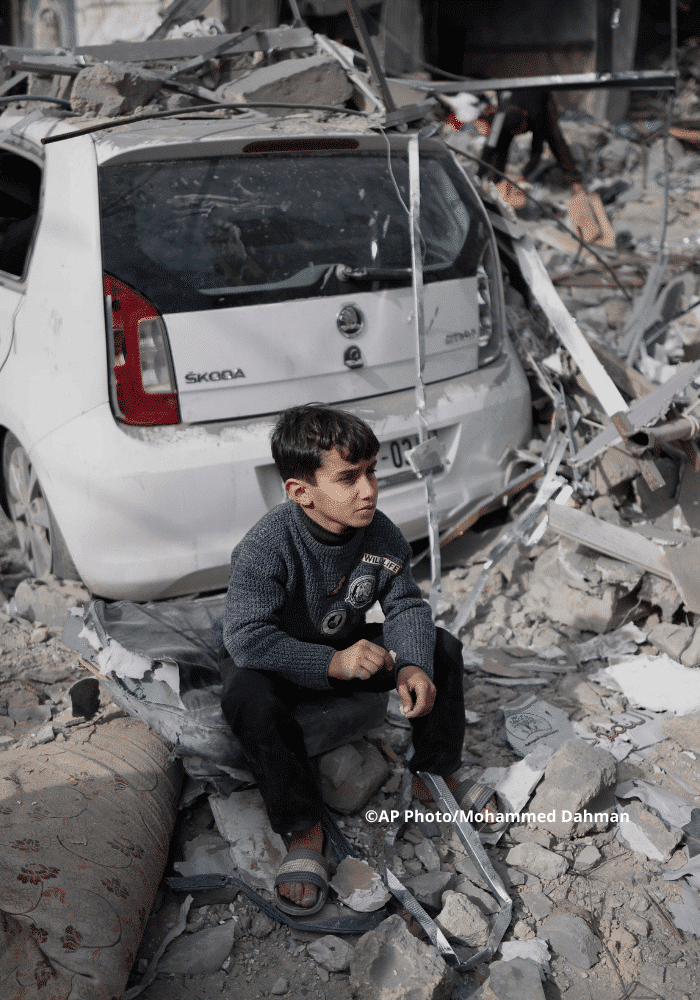
The Gaza Strip is a highly dense area of 365 km² housing 2.2 million inhabitants. Cut off from the world, the enclave has been under Israeli blockade for 16 years. Before the current crisis, public services were functional, but the humanitarian situation was already precarious. Since the start of the bombings on October 7 and the total siege imposed by the Israeli government on October 9, Gaza is facing a major humanitarian catastrophe. Public infrastructure has collapsed, particularly the health system and structures for drinking water supply. The destruction of homes, health facilities, schools, and other UNRWA (United Nations Relief and Works Agency for Palestine Refugees in the Near East) shelters has accelerated this collapse.
Most hospitals are barely functional. They face a severe shortage of medicines and medical equipment while being overwhelmed by the influx of injured and displaced persons. Gazans lack everything: water, food, fuel, and electricity. The population drinks contaminated water and eats one meal a day. 1.9 million people have been displaced by the bombings, often multiple times, and sleep in the streets or overcrowded shelters. The rise in cases of diarrhea, acute skin and respiratory infections, and hygiene-related infections raises fears of epidemics endangering the most vulnerable.
In the West Bank, over 330 Palestinians, including 84 children, have been killed by the Israeli army or settlers between October 7, 2023, and January 10, 2024 (compared to 144 in 2022). The majority lost their lives during the near-daily raids by the Israeli army. Targeting health infrastructure and ambulances multiple times, these raids prevent civilians from accessing care. Checkpoints have also been reinforced, restricting movement and posing an obstacle to accessing humanitarian aid or health facilities. Acts of violence by Israeli settlers against Palestinian civilians have drastically increased, from 3 per day before October 7 to an average of 7 per day now. Over 1,200 Palestinians have been forcibly displaced from their communities. Prevented from returning to their lands, they have lost everything. Due to the general insecurity, they have almost no access to basic services.
What is Médecins du Monde doing there?
Médecins du Monde has been present in Palestine since 1995, where we support access to health for civilian populations. We operate in the West Bank and the Gaza Strip to prepare healthcare structures for emergency situations and help them better coordinate their actions. Médecins du Monde provides psychosocial support to victims of violence by settlers and Israeli armed forces in the West Bank. Medical staff are trained to detect and manage psychosocial disorders and facilitate referrals to appropriate health structures.
Since October 7, Médecins du Monde’s humanitarian operations in Palestine have been severely affected. The catastrophic context in Gaza hinders our operations. Our team on the ground is in survival mode. Médecins du Monde has sent medical supplies to support the health system in Gaza. In the West Bank, mental health needs have increased due to the surge in violence by Israeli settlers. Our team continues to provide emergency psychosocial response on the ground.
How are your teams affected by the current situation?
In Gaza, all our team members are trying to survive the bombings and the humanitarian crisis. Like the rest of the civilian population, most have had to leave their homes. They drink unsafe water and eat once a day. Our colleague Maysara Rayyes, a 28-year-old emergency doctor and medical supervisor, was killed in the bombing of his building in Gaza City along with several family members. Another was injured when an Israeli tank attacked the school where he had taken refuge. Several childbirths have occurred in recent weeks. On average, 5,500 women give birth each month in Gaza.
What is Médecins du Monde calling for?
Médecins du Monde is calling for an immediate ceasefire and safe, unhindered humanitarian access to Gaza. We insist on the obligation of states to respect and ensure respect for international humanitarian law (IHL), which sets rules in war and protects civilians. We recall that humanitarian and medical personnel, as well as hospitals and schools, must never be targeted. We condemn all abuses committed against civilians, whether Palestinian or Israeli. IHL must be respected by all parties to the conflict.
We recognize that the Right to health of the Palestinian population is negatively affected by the Israeli occupation. Our organization therefore advocates for a lasting political solution addressing the root causes of international law and human rights violations in Palestine and Israel.
Read our report “No peace of mind”: mental health in Palestine (published in 2022)
What is Médecins du Monde’s mandate?
Médecins du Monde is a humanitarian medical non-governmental organization that fights for a fair and universal health system. As a humanitarian organization, the principles of humanity, impartiality, neutrality, and independence are at the core of our action.
We are committed to caring for the most vulnerable populations and to bearing witness to the obstacles they face in accessing care.
Are you intervening in Israel?
Médecins du Monde intervenes in countries where vulnerable populations face difficulties accessing care. Our organization can also act at the request of a country at risk of its health system collapsing. At this stage, Israel has not issued a humanitarian appeal.
Are you truly independent in Gaza?
The principles of independence and impartiality are at the heart of Médecins du Monde’s humanitarian action. Consequently, our operations, funding, and donations are solely intended for civilian populations. We work, in particular, to strengthen the health system by supporting hospitals, health centers, and healthcare personnel. As a humanitarian organization, we do not accept interference in the conduct of our operations.
Where do the figures you cite in your communications come from?
Regarding the current situation in Gaza, Médecins du Monde bases its communications and analyses on figures published by the United Nations Office for the Coordination of Humanitarian Affairs (OCHA) and the Health Cluster of the World Health Organization. We consider, as do several experts, that the number of people killed in Gaza is likely underestimated given the impossibility of counting bodies buried under the rubble.
What is your position regarding Israeli victims, particularly the hostages held by Hamas?
Médecins du Monde condemns all physical, sexual, and psychological violence against civilians, whether Palestinian or Israeli. We demand the protection of all civilians, including hostages. We recall that taking hostages is prohibited by international humanitarian law and may be considered a war crime. On October 18, we signed a petition calling for an immediate ceasefire in the Gaza Strip and the release of hostages.
We are not directly intervening with Israeli hostages in Gaza. Such actions fall under the mandate of the International Committee of the Red Cross (ICRC).
Images of an emergency training exercise conducted by Médecins du Monde in Gaza have been circulating on social media in recent weeks. What do they refer to?
These images were taken in 2017 as part of Médecins du Monde’s humanitarian operations in Gaza. They depict a medical emergency training exercise for healthcare personnel. Fake injuries were created by special effects makeup artists to enhance the realism for participants in the training exercise. These images are unrelated to the current situation in the region and have unfortunately been the subject of fake news on social media.