
We, the 250 undersigned organisations, call on all States to immediately cease transfers of arms, spare parts, and ammunition to Israel, as well as to Palestinian armed groups, as long as there is a risk that they may be used to commit or facilitate serious violations of international humanitarian law or human rights.
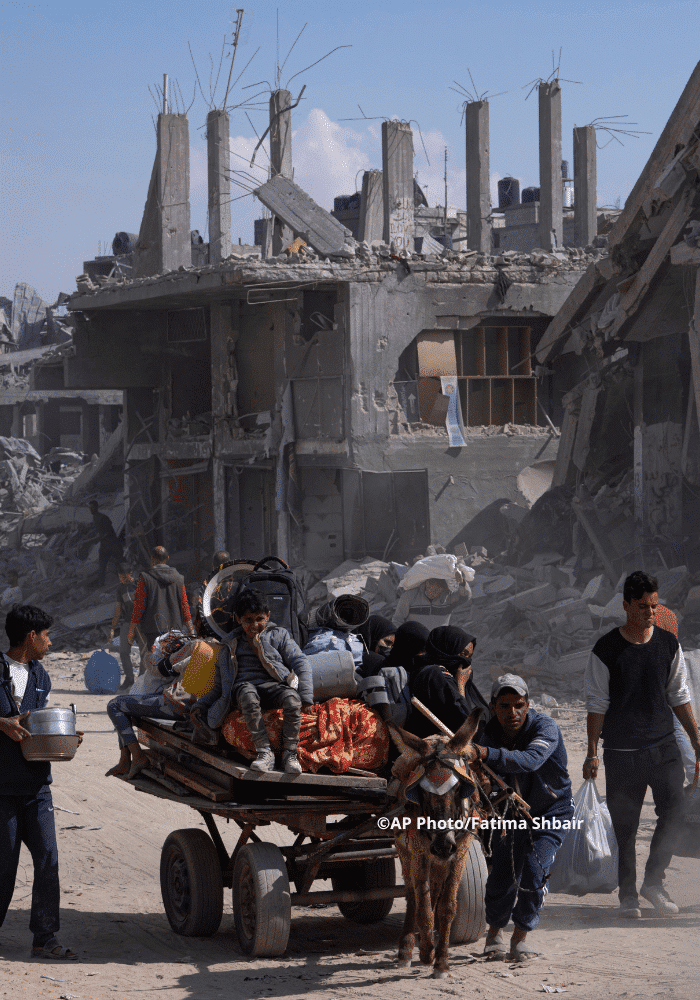
Israeli bombings and the siege are depriving the civilian population of the basic elements necessary for survival and making Gaza uninhabitable. Today, the civilian population of Gaza is facing a humanitarian crisis of unprecedented severity and scale.
Violations of International Humanitarian Law
Attacks carried out by Palestinian armed groups have killed approximately 1,200 people and taken hundreds of Israelis and foreigners hostage, including children, and continue to hold over 130 hostages inside Gaza. Armed groups in Gaza have continued to indiscriminately fire rockets at population centres in Israel, disrupting children’s classes at school and displacing and threatening the lives and well-being of civilians. Hostage-taking and indiscriminate attacks constitute violations of international humanitarian law and must cease immediately.
Humanitarian agencies, human rights advocacy groups, United Nations officials, and more than 153 Member States have called for an immediate ceasefire. However, Israel continues to use explosive weapons and ammunition in densely populated areas, resulting in severe humanitarian consequences for the population of Gaza. World leaders have urged the Israeli government to reduce civilian casualties, but Israeli military operations in Gaza continue to kill people at an unprecedented rate, according to recent statements by the UN Secretary-General. Member States have a legal responsibility to use all possible measures to ensure the protection of civilians and respect for international humanitarian law. Gaza’s last lifeline – an internationally funded humanitarian response – has been paralysed by the intensity of hostilities, including attacks on humanitarian convoys, recurrent communication service disruptions, damaged roads, restrictions on essential aid, an almost total ban on commercial goods, and a cumbersome bureaucratic process for sending aid to Gaza.
Destruction and Harm to Civilians
Israel’s military campaign has destroyed much of Gaza’s homes, schools, hospitals, water supply infrastructure, shelters, and refugee camps; these indiscriminate bombings, as well as the repeated disproportionate harm to civilians they systematically cause, are unacceptable. The UN High Commissioner for Human Rights has warned of the “increased risk of atrocity crimes” being committed in Gaza and called on all States to prevent such crimes. Since this call, the humanitarian crisis in Gaza has only worsened:
- Over 33,000 Palestinians, including at least 14,500 children, have been killed in the past six months, according to Gaza’s Ministry of Health. Thousands more are buried under the rubble and presumed dead.
- Over 75,000 people have been injured, many of whom have suffered permanent injuries leaving them with lifelong disabilities; among them, over 1,000 Palestinian children have been forced to undergo amputations of their upper or lower limbs.
- An undetermined number of Palestinian civilians, including children, have been unlawfully detained, according to the UN, and must be released.
- Palestinians continue to be killed almost daily in areas where the Israeli government instructed them to flee. During the first week of 2024, an Israeli airstrike killed 14 people – mostly children – near an area designated by Israeli forces as a “humanitarian zone.”
- Over 70% of Gaza’s population, or approximately 1.7 million people, have been forcibly displaced. Many followed Israel’s orders to move south and are now trapped in tiny areas lacking everything, unable to sustain human life, and which have become breeding grounds for disease.
Families Threatened by Famine
- Half of Gaza’s population – approximately 1.1 million Palestinians – is facing catastrophic levels of hunger and famine, the highest figure ever recorded by the humanitarian technical body responsible for assessing food insecurity based on evidence, with famine now imminent in northern Gaza. The entire population of the Gaza Strip – approximately 2.2 million people – is facing high levels of acute food insecurity.
- Over 70% of Gaza’s homes, much of its schools and water and sanitation infrastructure have been destroyed or damaged, leaving the population with very little access to clean water.
- No medical facility in the enclave is fully operational, and those partially functioning are overwhelmed with trauma cases and affected by shortages of medicines, medical supplies, and doctors. Over 489 medical staff have been killed.
- At least 243 humanitarian workers* in Gaza have been killed by Israeli bombings, more than in any other conflict this century.
“GAZA IS TODAY THE MOST DANGEROUS PLACE IN THE WORLD FOR A CHILD, A JOURNALIST, AND A HUMANITARIAN WORKER.”
Hospitals and schools should never become battlefields. These conditions have created a situation of total despair inside Gaza, leading senior humanitarian officials to declare that the necessary conditions for an adequate humanitarian response in Gaza no longer exist. This will not change as long as the siege, bombings, and fighting do not cease. In January, the United Nations described humanitarian access in January as “significantly deteriorated.” Israeli forces have repeatedly denied permission for humanitarian convoys to reach areas north of Wadi Gaza, where the population faces the greatest risk of famine.
In recent weeks, senior Israeli officials have begun calling for the expulsion of Palestinian civilians from Gaza. Forced displacement within Gaza and the deportation of part of the population beyond its borders, without any guarantee of return, would constitute serious violations of international law, amounting to an atrocity crime.
We Demand an Immediate Ceasefire
We demand an immediate ceasefire and call on all States to end arms transfers that may be used to commit violations of international humanitarian law and human rights. The UN Security Council must fulfil its responsibility to maintain international peace and security by adopting measures to halt arms transfers to the Israeli government and Palestinian armed groups and to prevent arms transfers that risk being used to commit international crimes, and this immediately.
All States have an obligation to prevent atrocity crimes and promote respect for the norms that protect civilians. It is high time the international community lived up to these commitments.
* The total number of humanitarian workers killed includes employees of the UN, NGOs, and the Palestinian Red Crescent. The annual number of humanitarian workers killed in other contexts is available in the Aid Worker Security Database.