
<h1> The siege imposed by the Israeli authorities is causing an unprecedented famine in the Gaza Strip. </h1>
Humanitarian workers are forced to queue for a few food supplies, risking being targeted. Stocks are now exhausted. In the field, NGOs see their staff and partners wasting away before their eyes.
Two months after the launch of the Gaza Humanitarian Foundation — an organization under the control of the Israeli government — over 100 organizations are urging the international community to act. They are calling for the immediate reopening of all land crossing points. They demand the restoration of food, drinking water, medicine, shelter, and fuel supplies. This aid must be coordinated through a humanitarian mechanism based on the principles of international law and led by the United Nations. The organizations are also demanding an end to the siege, as well as an immediate ceasefire.
Hunger as a weapon of war: read our report
<h2>“Every morning, the same question echoes in Gaza: will I eat today?” testimony from the representative of a humanitarian organization in Gaza.</h2>
<h1>Food distributions turn into near-daily massacres.</h1>
As of July 13, the UN has confirmed that 875 people have been killed while trying to obtain food. 201 of them died on aid delivery routes, and others at distribution points. Thousands have been injured.
Nearly two million Palestinians have been forcibly displaced. On July 20, a new evacuation order reduced their living area to less than 12% of the Gaza Strip. The World Food Programme (WFP) has stated that current conditions make operations untenable. The instrumentalization of famine constitutes a war crime.
Yet, tons of essential supplies — food, water, medicine, shelter, fuel — remain stuck in warehouses, both outside and inside Gaza, without humanitarian organizations being able to access them. The restrictions imposed by Israel have plunged the territory into chaos, famine, and death. A humanitarian worker providing psychosocial support describes the devastating consequences for children: “Children tell their parents they want to go to paradise, because at least there, they will have something to eat.”
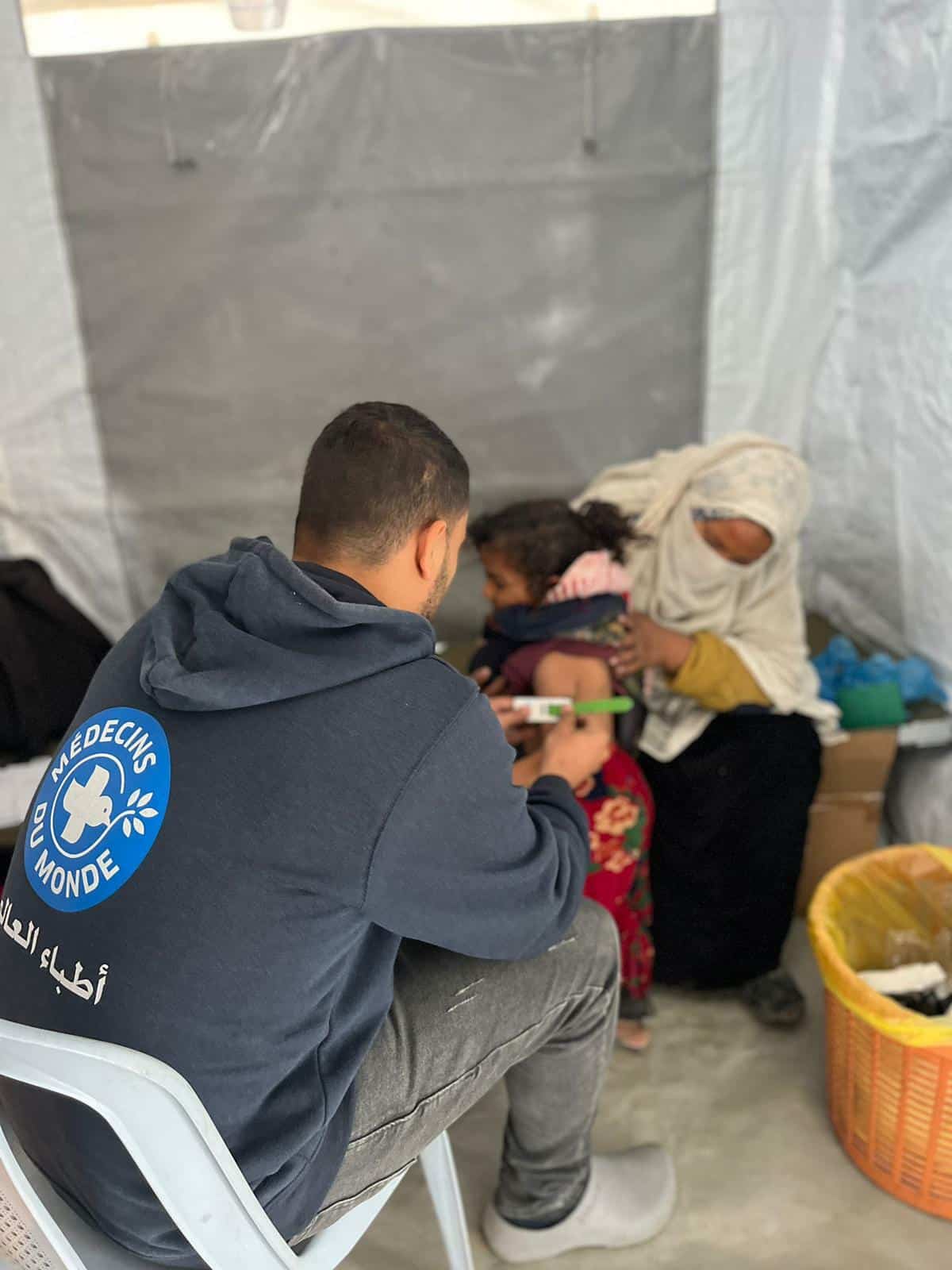
Doctors are reporting record levels of acute malnutrition, particularly among children and the elderly. Diseases such as watery diarrhea are proliferating, and markets are empty. Waste is piling up, and adults are collapsing from hunger and thirst in the streets. On average, only 28 aid trucks enter Gaza each day; this number is far too insufficient for over two million people. Many have not received any aid for weeks.
Learn more about our actions in Palestine
<h1>The UN-led international humanitarian system has not failed; these obstacles prevent it from fully fulfilling its role.</h1>
Humanitarian organizations have the resources to intervene on a large scale, but access is denied to them. We cannot assist the populations or our teams.
On July 10, the European Union and Israel announced measures to scale up aid. However, no real change has been observed on the ground. Each day without adequate humanitarian aid results in loss of life. Children are dying while waiting for promises that remain unfulfilled.
In Gaza, the wait for aid and a ceasefire has turned into an endless cycle of hope and despair. This is not just physical suffering, but also psychological. Survival has become nearly impossible. Humanitarian workers cannot operate in uncertainty or rely on political commitments that repeatedly fail.
Governments must stop waiting for permission to act. We can no longer hope that the current arrangements will work. It is imperative to demand an immediate and permanent ceasefire, lift all administrative restrictions, and reopen crossing points. It is essential to ensure full access to the entire Gaza Strip and put an end to militarized distribution. A UN-led humanitarian response must be restored, and impartial and independent actions must be funded. States must take concrete steps to end the siege, including halting the transfer of arms and ammunition.
Symbolic actions, such as airdrops or partial aid agreements, remain insufficient. States have a moral and legal responsibility to protect Palestinian civilians and must guarantee large-scale humanitarian access.
Signatories
- American Friends Service Committee (AFSC)
- A.M. Qattan Foundation
- A New Policy
- ACT Alliance
- Action Against Hunger (ACF)
- Action for Humanity
- ActionAid International
- American Baptist Churches Palestine Justice Network
- Amnesty International
- Asamblea de Cooperación por la Paz
- Associazione Cooperazione e Solidarietà (ACS)
- Bystanders No More
- Campain
- CARE
- Caritas Germany
- Caritas Internationalis
- Caritas Jerusalem
- Catholic Agency for Overseas Development (CAFOD)
- Center for Mind-Body Medicine (CMBM)
- CESVI Fondazione
- Children Not Numbers
- Christian Aid
- Churches for Middle East Peace (CMEP)
- CIDSE- International Family of Catholic Social Justice Organisations
- Cooperazione Internazionale Sud Sud (CISS)
- Council for Arab‐British Understanding (CAABU)
- DanChurchAid (DCA)
- Danish Refugee Council (DRC)
- Development and Peace – Caritas Canada
- Doctors against Genocide
- Episcopal Peace Fellowship
- EuroMed Rights
- Friends Committee on National Legislation (FCNL)
- Forum Ziviler Friedensdienst e.V.
- Gender Action for Peace and Security
- Glia
- Global Legal Action Network (GLAN)
- Global Witness
- Health Workers 4 Palestine
- HelpAge International
- Human Concern International
- Humanity & Inclusion (HI)
- Humanity First UK
- Indiana Center for Middle East Peace
- Insecurity Insight
- International Media Support
- International NGO Safety Organisation
- Islamic Relief
- Jahalin Solidarity
- Japan International Volunteer Center (JVC)
- Justice for All
- Kenya Association of Muslim Medical Professionals (KAMMP)
- Kvinna till Kvinna Foundation
- MedGlobal
- Medico International
- Medico International Switzerland (medico international schweiz)
- Medical Aid for Palestinians (MAP)
- Mennonite Central Committee (MCC)
- Medicine for the People – Belgium (MPLP/GVHV)
- Médecins Sans Frontières (MSF)
- Médecins du Monde France
- Médecins du Monde Spain
- Médecins du Monde Switzerland
- Mercy Corps
- Middle East Children’s Alliance (MECA)
- Movement for Peace (MPDL)
- Muslim Aid
- National Justice and Peace Network in England and Wales
- Nonviolence International
- Norwegian Aid Committee (NORWAC)
- Norwegian Church Aid (NCA)
- Norwegian People’s Aid (NPA)
- Norwegian Refugee Council (NRC)
- Oxfam International
- Pax Christi England and Wales
- Pax Christi International
- Pax Christi Merseyside
- Pax Christi USA
- Pal Law Commission
- Palestinian American Medical Association
- Palestinian Children’s Relief Fund (PCRF)
- Palestinian Medical Relief Society (PMRS)
- Peace Direct
- Peace Winds
- Pediatricians for Palestine
- People in Need
- Plan International
- Première Urgence Internationale (PUI)
- Progettomondo
- Project HOPE
- Quaker Palestine Israel Network
- Rebuilding Alliance
- Refugees International
- Saferworld
- Sabeel‐Kairos UK
- Save the Children (SCI)
- Scottish Catholic International Aid Fund
- Solidarités International
- Støtteforeningen Det Danske Hus i Palæstina
- Swiss Church Aid (HEKS/EPER)
- Terre des Hommes Italia
- Terre des Hommes Lausanne
- Terre des Hommes Nederland
- The Borgen Project
- The Center for Mind-Body Medicine (CMBM)
- The Global Centre for the Responsibility to Protect (GCR2P)
- The International Development and Relief Foundation
- The Institute for the Understanding of Anti‐Palestinian Racism
- Un Ponte Per (UPP)
- United Against Inhumanity (UAI)
- War Child Alliance
- War Child UK
- War on Want
- Weltfriedensdienst e.V.
- Welthungerhilfe (WHH)