
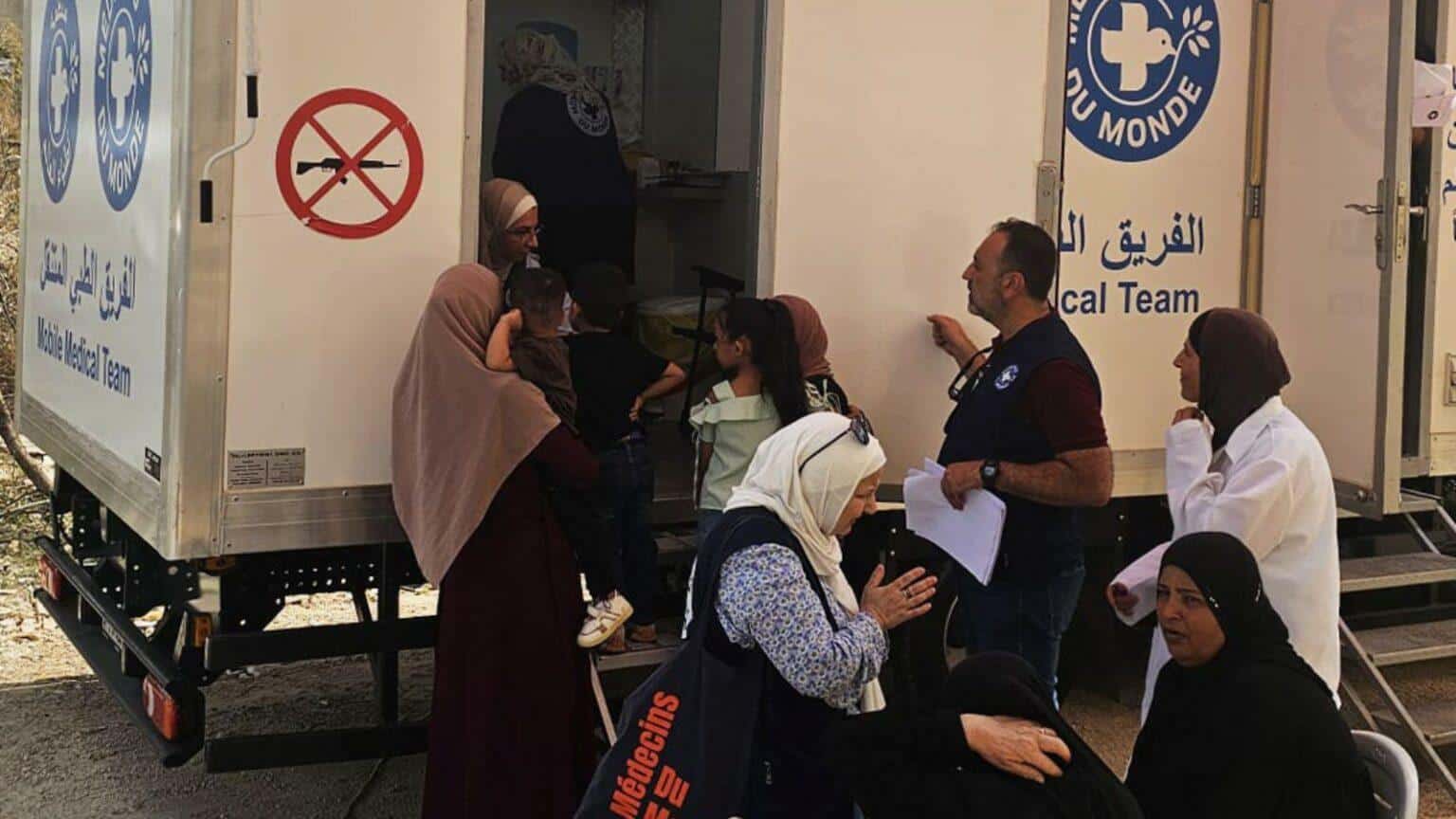
Since the beginning of 2025, over 44,000 people have been expelled from their homes, following an escalating offensive that has generated the largest wave of expulsions since 1967. While the numbers speak for themselves, behind each figure lie separated families, abandoned memories, and a constant sense of uncertainty and exhaustion. What happens when a community lives between raids, bombings, and restrictions? What about the mental health of those who lose not only their homes but also their sense of security, stability, and belonging?
Médecins du Monde’s report, compiled between 2024 and 2025 in various refugee camps, documents the psychological effects of the Israeli occupation on Palestinian refugees in the West Bank. It draws on clinical data and testimonies, revealing deep patterns of psychological trauma that transcend generations and affect both adults and children. The analysis includes assessments, records of recurring symptoms, and longitudinal observations that identify trends in the evolution of trauma under conditions of extreme stress.
Read the summary version of the report
98% of individuals supported by our team show severe signs of distress
Constant hypervigilance
In the refugee camps of Jenin, Tulkarem, and Nur Shams, daily life has become a matter of survival due to military operations linked to the Israeli military presence. Assaults occur without warning and continuously. Bombings, destruction of infrastructure, disruptions to basic supplies, and more.
How can one rebuild a home when there is no guarantee it will still be standing tomorrow? Mental health professionals emphasize that this type of intermittent yet chronic exposure generates cycles of hypervigilance, a common symptom among victims of violence in the West Bank.
Violence does not merely expel families from their homes; it forces them to live in a state of constant alert, a psychological mechanism that, when sustained over time, leads to evident emotional exhaustion. The figures confirm this: 96% of individuals supported by Médecins du Monde report that the occupation interferes with their daily lives, and 98% exhibit severe signs of distress. All of this points to a rapid deterioration in the mental health of Palestinian refugees.
Trauma and intergenerational transmission
The psychological harm documented by Médecins du Monde is vast and profound. According to data collected during second psychosocial visits, 70% of individuals exhibited symptoms such as hopelessness, chronic stress, psychosomatic disorders, or a sense of learned helplessness. Additionally, 74% had faced multiple violent incidents in just four months. This data reveals a pattern of continuous exposure to psychological trauma that prevents the natural process of emotional healing.
In this context, a critical question arises: how can a community heal when there is no safety, no stability, and no time to overcome the trauma experienced, especially when it remains ongoing? The military presence does not only cause immediate harm; it also erodes the conditions necessary for psychological recovery. The inability to feel safe, combined with the constant threat, the loss of loved ones, and the loss of one’s home, turns this trauma into a vicious cycle that is difficult to break.
This vicious cycle also has an intergenerational component, meaning that this situation creates trauma in which past experiences intertwine with the anticipation of future harm, generating an existential fear that endangers the collective Palestinian identity and fuels intergenerational trauma.
In this scenario, children are the most vulnerable. Many suffer from regression, severe anxiety, or accelerated emotional maturation that forces them to “grow up before their time.” Their homes and schools—spaces that should be safe—are invaded or destroyed, eliminating their physical and psychological refuges.
The suffering caused by the Israeli occupation meets the criteria for psychological torture
The report’s findings argue that the suffering caused by the Israeli occupation meets the criteria for psychological torture, according to United Nations standards.
The combination of aggression, forced displacement, the devastation of living environments, and the lack of protection creates continuous suffering that prevents individuals from leading a dignified life. Indeed:
- There is no safe place to rest
- There is no stability to rebuild
- There is no time to overcome the trauma experienced
All of this significantly weakens the resilience mechanisms that any person may possess.
In this context, Médecins du Monde’s recommendations aim to restore minimal conditions of dignity and protection:
- Ensure the end of the occupation in accordance with the ICJ’s advisory opinion.
- Put an end to practices that may constitute psychological torture.
- Restore access to mental health care in Palestine and to humanitarian aid.
- Protect UNRWA’s mandate.
- Lift movement restrictions that prevent access to fundamental rights.
- Can there be psychological recovery without justice, freedom, and guarantees of non-repetition? The report clearly states that there cannot.
Psychological recovery is only possible with the end of the occupation
The situation in the West Bank is not only a humanitarian crisis but also a large-scale emotional and psychological crisis. Israel’s military violence in the West Bank destroys homes and the ability of individuals to live without fear, to imagine a future, or to protect themselves from psychological harm and trauma. The report’s technical findings indicate that, without a safe environment and the end of the Israeli occupation, any mental health intervention in the West Bank has limited impact.
Psychological recovery for the Palestinian people will only be possible with the end of the occupation, respect for human rights, and guaranteed access to health care, including mental health interventions.