
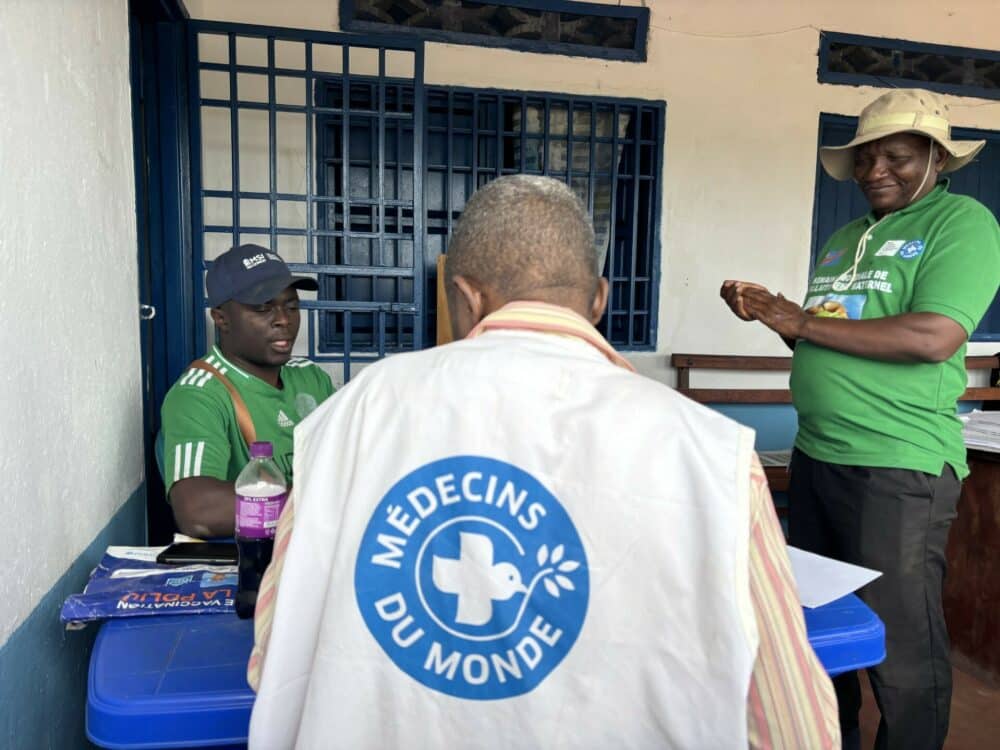
TANGANYIKA: A PROVINCE TESTED BY CRISES
Located in the east of the Democratic Republic of the Congo, Tanganyika province faces multiple vulnerabilities: geographic isolation, impassable roads, intercommunal tensions between the Twa and Bantu, and an influx of displaced people fleeing M23 fighting in the neighbouring provinces of North Kivu and South Kivu. Food insecurity, recurring epidemics — cholera, measles, mpox — and cuts to international humanitarian funding are worsening an already fragile health situation.
It is in this context that Doctors of the World Canada operates, with support from Global Affairs Canada, in three health zones: Nyemba (Kisonja health centre), Kalemie (Katibili health centre) and Nyunzu (Lwizi health centre). The goal: to guarantee free access to quality care for the most vulnerable populations, particularly women, children and internally displaced persons.
The project covers primary health care, nutrition, reproductive health, prevention of and response to gender-based violence (GBV), and psychosocial support. It was launched in a particularly challenging operating environment, marked by temporary suspensions of travel for security reasons and rainy seasons that make some roads inaccessible.
Three faces of impact: testimonies from the field
RACHEL, 43 — “I AM BEING CARED FOR”
Rachel lives in the village of Lugogo II, about ten kilometres from the Kisonja health centre. A mother of nine and the wife of the village chief, she depends, like most households in the area, on farming with uncertain harvests. Before support from MdM and GAC, getting care meant a 50-kilometre trip to Kalemie on roads in very poor condition, with transport costs out of reach for families with limited resources.
In February 2026, Rachel arrived at the Kisonja health centre in critical condition: widespread pain, intense fatigue and difficulty breathing. She had walked for several hours from her village, after getting up at 5 a.m. She immediately received a blood transfusion, injections and full treatment — free of charge.
“Before the Kisonja health centre was supported, we had to go to Kalemie to get quality care.” — Daniel, village chief (name changed)
What made them decide to go? Hearing that care was free. Rachel particularly appreciates the referral system set up by MdM: when a case exceeds the capacity of the Kisonja centre, the organization covers round-trip transport to the referral facility in Kalemie, as well as meals for the patient and the person accompanying them. Her message, translated from Swahili, is simple:
“That they can treat us, and that we can be healed.” — Rachel (name changed)
SABINE, 30 — TAKING BACK CONTROL OF HER REPRODUCTIVE HEALTH
Sabine lives in Kisonja, a few metres from the health centre supported by MdM. Like many women in the area, she faced a double barrier: financial and geographic. “Everywhere we went for care, we had to pay,” she explains. These repeated costs made access to care uncertain, or even impossible, for her household.
When one of her children fell seriously ill with severe anemia, the child was treated free of charge at the health centre and then referred urgently to the Undugu facility in Kalemie. Sabine was able to accompany her child there and also received full support herself, including care and food.
The project also transformed her relationship with reproductive health. After having had four abortions, Sabine was able to attend information sessions and receive individual counselling on contraceptive methods. She has now chosen to use an injectable method, entirely free of charge. This support has allowed her to better plan her pregnancies and take back control of her reproductive choices.
Sabine also takes part in community awareness sessions led by MdM and is part of a women’s network committed to preventing GBV. She is seeing gradual changes in behaviour within her family and community.
“I hope the support will continue so that access to care and awareness activities can be maintained.” — Sabine (name changed)
ALICE, 27 — A LIFE SAVED THANKS TO EMERGENCY CARE
Alice lives in Kisonja. During her last pregnancy, complications arose that required rapid care at the local health centre. Given the seriousness of the situation, she was referred to the referral health facility in Kalemie, where she underwent an emergency caesarean section.
After the operation, Alice and her newborn were able to return to Kisonja for postnatal follow-up. All of her care — transport, surgery and postnatal care — was provided free of charge thanks to the GAC-funded project.
Alice has no financial resources of her own. Without this project, the costs of the surgery, transport and care would have been out of reach. She also highlights the importance of the psychosocial support services offered to GBV survivors, which women around her have benefited from — support that goes beyond medical care alone.
A vital project in a context of protracted crisis
The testimonies of Rachel, Sabine and Alice illustrate a documented reality: in the isolated rural areas of Tanganyika, free care is not a secondary benefit — it is the very condition for access to health. Without the support of Doctors of the World Canada and Global Affairs Canada, women would give birth without assistance, anemic children would not receive transfusions, and obstetric emergencies would turn into tragedies.
The project shows that a coordinated humanitarian intervention — combining free primary care, structured referrals, reproductive health, GBV prevention and psychosocial support — can produce concrete, measurable results, even in the most difficult contexts.
Doctors of the World Canada will continue to advocate for this type of intervention to be supported, scaled up and sustained.