
CONTEXT
PANDEMICS KNOW NO BORDERS
→ Show your support by signing our statement
These are difficult times for everyone on a global scale. The COVID-19 epidemic has become a source of deep concern for most of us, and for some, even a matter of life or death. But it also represents a unique challenge to uphold the right to health for all, meaning an opportunity for public health systems to ensure equitable access to health, to challenge national and global health governance, and to rethink the purpose of international cooperation with countries in the Global South. Overall, this crisis is undermining global health policies.
Significant questions have arisen since the pandemic was officially declared: To what extent are national health systems prepared to handle a crisis of this magnitude? How can states, through their public health systems, ensure respect for the right to health for all, non-discrimination, equitable and affordable access to health without leaving anyone behind, the availability of regular and sufficient funds to cover expenses related to supplies, facilities, trained health personnel, effective information systems, adequate service delivery, access to essential medicines, and democratic governance… funds to counter the pandemic? What will happen to the health systems of already weakened countries in the Global South?
The dismantling of public welfare state services (through privatization, commercialization, underfunding, and regionalization) has led to the degradation of public health systems worldwide. The weaknesses currently faced by health systems reflect the difficulties and challenges they must overcome to combat the pandemic and ensure equitable access and treatment for all. The lockdown measures imposed on a large portion of the population, as well as the declaration of a state of emergency or alert in many countries, are merely the result of the lack of resources and capacity in care centers and hospitals to treat such a large number of infected individuals.
Special attention must be paid to the discrimination faced by women and girls in accessing health services and treatments, particularly in the poorest countries. Social, cultural, and gender norms, as well as inequalities in roles and relationships, influence the vulnerability of women and men to infection, exposure, and access to treatment.
Furthermore, among the most fragile populations, the Roma community, detainees, people experiencing homelessness, PWID, refugees, and migrants are traditionally excluded from national public health systems due to their social, cultural, or legal status and are therefore the most vulnerable during health crises. This is particularly the case for older migrants whose family reunification process is underway and who, despite the legality of their status, are denied access to public health services. People experiencing homelessness have more difficulty accessing health centers and are only taken in by emergency services when their situation has become too severe to ignore. They already face significant stigmatization under normal circumstances, and when health services are overwhelmed, they are met with rejection—rejection that leads to even more difficult access to care and a higher likelihood of transmission. Finally, people experiencing homelessness may face additional challenges in following prevention recommendations, such as washing their hands.
In the fight against COVID-19, the challenge is even greater when public health systems are weak or disorganized due to pre-existing conflicts and resulting chaos. In conflict-affected areas, the pandemic can have disastrous consequences, adding a crisis to the crisis. Refugees and displaced populations, weakened by months or even years of violence or lack of health services and living in overcrowded places, are particularly exposed. In a humanitarian crisis context, this pandemic has a huge impact on the accessibility of supplies and personnel.
The COVID-19 pandemic teaches us that strong public health systems are capable of withstanding massive health threats through appropriate collective measures. Similarly, it highlights the importance of having a true universal health system—guaranteeing the right to health and access to care for all, regardless of location or administrative or legal status—which appears to be the most effective strategy for addressing these health crises.
RECOMMENDATIONS
We call on health and development policymakers at the local, national, regional, and international levels to consider the following recommendations:
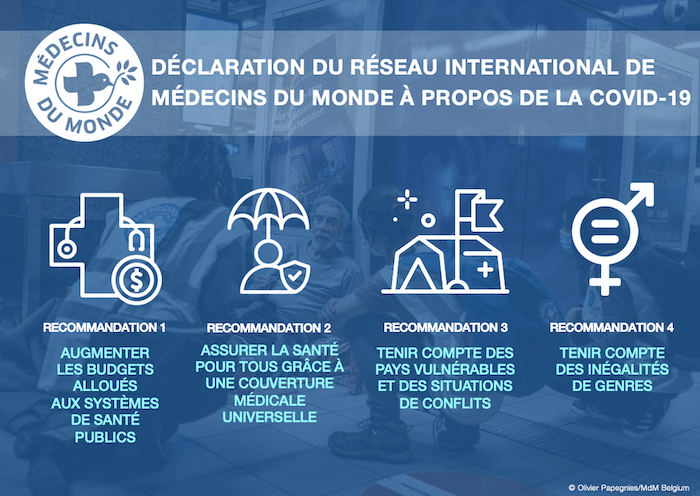
- In the long term, it is recommended to ensure public health spending and increase investment in public rather than private healthcare. Guaranteeing public spending and investments in care will enable our health systems and personnel to meet the needs of everyone through strong universal public health systems, free from private interests and profit-seeking.
- Each country should comply with the WHO recommendation to “[…] immediately allocate or reallocate at least an additional 1% of GDP to primary health care […]” by improving “[…] fiscal performance and domestic revenue in line with the Addis Ababa Action Agenda, to increase public revenue […]1”.
- To avoid discrimination in access to public health services, payment for tests and care should be eliminated.
- Urgent coordinated action is needed, not only within our own local health systems but also at the national and international levels. What we need now is a strong and supportive health system for all, as well as coordination that extends beyond each country’s borders, with effects felt at both the national and global levels.
- It is essential to ensure that the fight against COVID-19 does not reproduce or perpetuate harmful gender norms, discriminatory practices, and inequalities. It is important to recognize that norms, roles, and social, cultural, and gender relations influence the vulnerability of women and men to infection, exposure, and treatment.
- Special measures should be put in place for the most vulnerable individuals, including people experiencing homelessness, migrants with precarious status, refugees, members of the Roma community, incarcerated individuals, and those who have difficulty accessing primary health care services—including refugees, particularly those living in camps—and displaced populations. Persons without status also need care: their access to health systems must not lead to the sharing of their data with immigration authorities.
- States must ensure that all individuals, including the most vulnerable, have access to all health measures. Unequally distributed resources could compromise virus control.
- It is crucial to recognize the specific needs of vulnerable countries with weak health systems and to take necessary measures to ease travel bans and movement restrictions to allow international aid to reach those who need it most.
- Special attention must be given to conflict situations. Refugees and displaced populations are particularly vulnerable to the pandemic, especially when living in camps. It is necessary to maintain humanitarian flights for the delivery of medical personnel and supplies to ensure the continuity of existing programs, as well as to guarantee the safety of personnel in the field.
- We need quality, rapid, and free health services for all.
- It is imperative to recognize the crucial role played by health workers (up to 80% of health practitioners are women) during a crisis like this. It is urgent to support them, as well as their unions and their demands for sufficient staff and protective equipment. Health professionals must be protected, particularly in conflict or crisis situations. They must not be targeted, and their work must not be hindered.
- We must ensure permanent, cultural, financial, and geographical access to health for all individuals, regardless of their legal or administrative status: let us provide true universal health coverage.
- It is necessary to ensure democratic governance of health at both the national and international levels. A strong and well-funded United Nations system, including the WHO and other relevant UN agencies, is needed to ensure a monitoring and control function.
- The distribution of medicines must serve the population and not transnational pharmaceutical companies. To this end, it is necessary to ensure that the development of new medicines or vaccines is not subject to the patent system or that access to them is not restricted.