
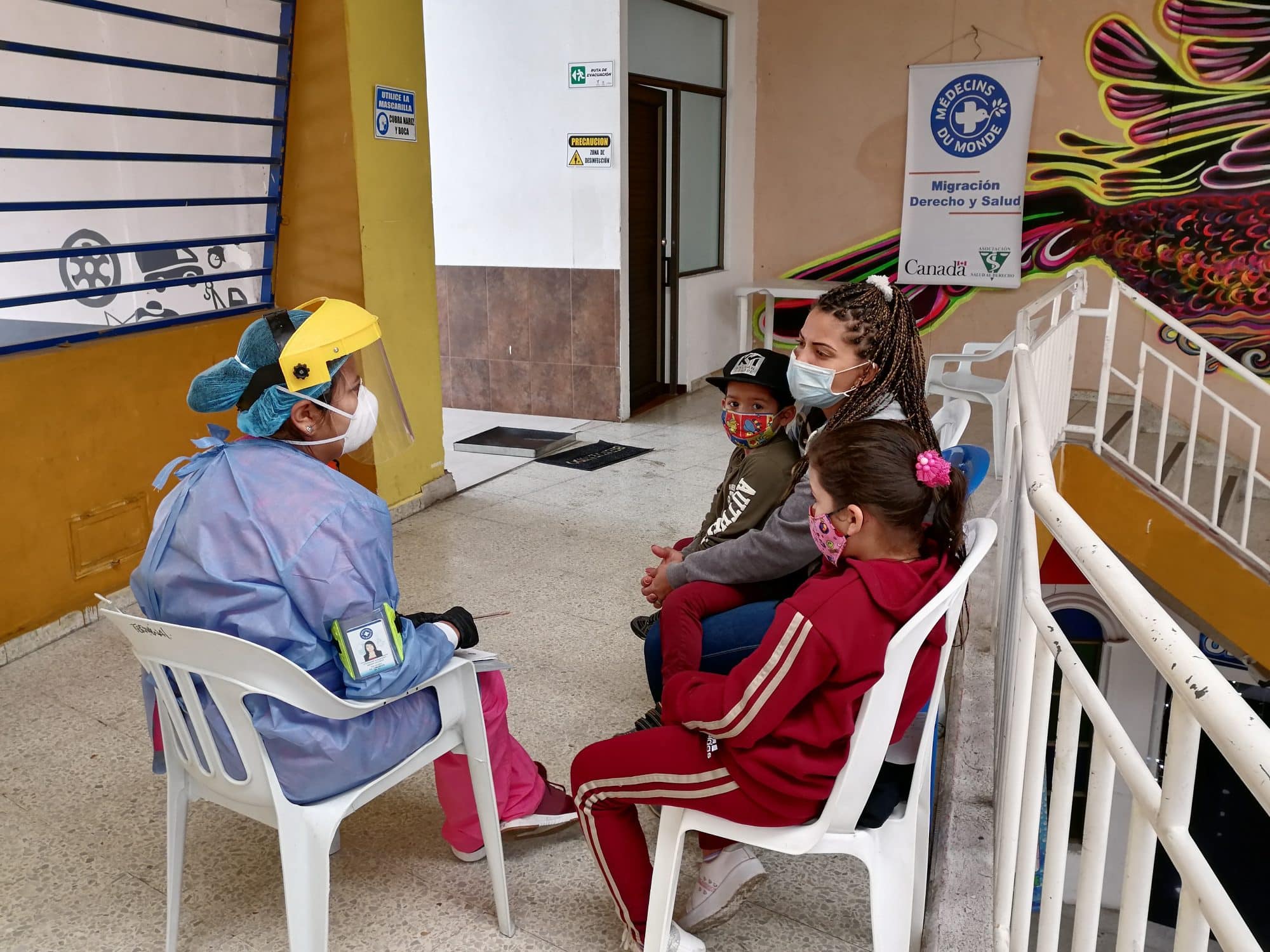
Montreal, June 15, 2021
In May 2021, an estimated 5.6 million people left Venezuela due to the complex situation in the country. Colombia is the South American country hosting the largest number of people, with a total of 1.7 million, including 762,826 in a regular administrative situation and 966,714 in an irregular situation. This number could be even higher, as a recent survey conducted by Doctors of the World among caminantes [1] traveling to Ecuador between March and May 2021 found that 84% of them entered Colombia through illegal routes.
It is estimated that in Colombia, 70% of the migrant population in a regular situation is not integrated into the health insurance system that provides access to medical care. According to the survey conducted by Doctors of the World among migrants in an irregular situation, 98% of them do not have health coverage, and only 10% were able to access medical care when needed.
According to this study, one in four migrants eats only once a day, 80% of women do not know how to access sexual and reproductive health services, and 50% of children under five have an incomplete vaccination record.
We identified several health issues among migrants related to the journey on foot from Venezuela to Ecuador, including respiratory infections, cases of chronic hypertension, asthma, and diabetes, as well as difficulties accessing sexual and reproductive health services, particularly prenatal check-ups.
Additionally, the vast majority of people in transit require basic first aid. They show signs of worsening physical condition, dehydration, fatigue, and injuries and wounds to the lower limbs, such as blisters on their feet. These lesions are caused by long walks with inadequate or worn-out footwear, exposure to harsh weather conditions, and unsanitary living conditions during their migration journey in Colombia.
Mental health also deserves special attention. Indeed, 38% of migrants in transit reported feeling sadness or anxiety. The vast majority stated they had not received any psychological care despite their extreme vulnerability, discrimination, or mistreatment they experienced. Meanwhile, 33% reported having been victims of assault, and 31% had experienced discrimination. Regarding the pandemic, preliminary data indicate that only 1.3% of caminantes contracted COVID-19. However, while many migrants reported experiencing flu-like symptoms, 90% said they had not been tested. All stated they did not know how to access vaccination, and 40% said they had no intention of getting vaccinated.
In recent years, the Colombian Ministry of Health and its partners have made numerous efforts at various levels to provide medical care to migrants, primarily through hospital emergencies. The same has been true for international cooperation humanitarian partners, who have focused more on primary health care. However, it is undeniable that with the onset of the pandemic, health services have operated at the limit of their capacity, which has inevitably significantly reduced access to medical care for migrants, especially for those without health coverage—the majority—and who have been in a situation of extreme vulnerability since the beginning of the pandemic, both in terms of health and socially and economically.
This extraordinary situation requires increased efforts from all stakeholders to ensure migrants’ access to health care services and to protect their right to health by improving their living conditions, particularly by working on the determinants of health that influence the migration process.
As part of the Second International Donors’ Conference in Solidarity with Venezuelan Refugees and Migrants, preparatory meetings, and side events, we call on the Colombian, Canadian, and French governments, the European Union, the Inter-American Development Bank, WHO/PAHO, UNHCR, IOM, and other United Nations system agencies, as well as the international community at large, to increase efforts and available resources for the health response to the humanitarian crisis caused by the rise in mixed migration flows from Venezuela.
More specifically, we would like to draw particular attention to certain health issues to better implement the 2021 Regional Refugee and Migrant Response Plan:
To the international community and donors, we request increased funding and resources allocated to the health sector, with special attention to the most vulnerable populations without health coverage. In the context of the pandemic, it is crucial to strengthen health systems and improve working conditions for healthcare workers. It is also necessary to promote greater international technical and scientific cooperation to generate more evidence and knowledge on health and migration.
To the member countries of the Quito Process, we urgently call for the establishment of a regional coordination mechanism to ensure universal access to health and the right to health, as established in General Comment No. 14 of the United Nations Economic and Social Council and in the International Covenant on Economic, Social and Cultural Rights (ICESCR), as well as in the laws and constitutions of all countries on the continent.
To the Colombian government, we request a clear and rapid acceleration of the affiliation of migrants to the General Social Security System under the new Temporary Protection Status for Venezuelan Migrants (Estatuto Temporal de Protección para Migrantes Venezolanos, ETPV), and to facilitate their insurance through Health Promoting Entities (Empresas Promotoras de Seguros de Salud, EPS) and access to all essential health services established by the Mandatory Health Plan (Plan Obligatorio de Salud, POS).
To the Colombian Ministry of Health, we respectfully suggest:
- Establishing an effective healthcare pathway for people in transit, newly arrived migrants, or migrants in an irregular situation who are not eligible for the ETPV, to address high-cost chronic diseases and ensure these patients have access to primary health care and medical emergencies, and to respond to health disasters.
- Strengthening primary health care (Atención Primaria de Salud, APS) and health promotion and prevention (Promoción y Prevención, PyP) actions to increase migrants’ access to sexual and reproductive health services, prevention and management of gender-based violence and sexual violence, as well as access for migrant children, regardless of their administrative status, to the Expanded Immunization Program (Programa Ampliado de Inmunizaciones, PAI), and to monitoring of growth, development, and child nutrition.
- Implementing a community-based mental health and psychosocial support strategy for migrants, particularly women, adolescents, and LGBTQ2S+ persons, including prevention of psychoactive substance use.
- Ensuring that patients with chronic diseases (hypertension, diabetes, cancer, heart diseases) are included as a priority vulnerable group in food assistance and livelihood programs and in the CASH program.
- Persisting in efforts by states and various institutions and organizations to prevent gender-based violence, sexual violence, sexual exploitation, and all forms of violence against children, and to ensure effective care for victims, regardless of their migration status.
- Defining an effective and equitable mechanism for migrants, people in transit, or those in an irregular situation to access the COVID-19 vaccine. We propose to WHO/PAHO that through the COVAX mechanism, a quota of vaccines, ideally single-dose, be established for this population group. Similarly, efforts must continue to ensure these individuals have access to screening, dignified isolation in case of direct contact, and necessary medical care if infected.
- Combating discrimination and xenophobia against the migrant population and ensuring that such violence does not occur within the health system. To this end, it is essential to train and raise awareness among health professionals and to severely punish those who commit such offenses.
- Recognizing the skills, titles, and diplomas of Venezuelan health professionals in Colombia and authorizing them to practice. MdM has accessed, through Venezuelan organizations in Colombia, a database of over a thousand health professionals, including many medical specialists, a human talent that cannot be wasted, especially during a pandemic.
In the context of the pandemic and the migration crisis, we now more than ever echo the theme of World Health Day, also promoted by the World Health Organization: “Health for all: protect everyone.”
[1] In Colombia, they are called “caminantes,” the millions of “walkers,” women, men, and children, who flee the crisis in Venezuela on foot.