
ONE OF THE WORLD’S MOST DANGEROUS MIGRATORY ROUTES
Every year, tens of thousands of people cross the Darién, the jungle that separates Colombia from Panama, in the hope of reaching North America. In 2024, 302,203 migrants crossed this border — a 41% decrease compared to the previous year, a direct result of more restrictive migration policies adopted in Panama, the change of government in the United States, and the ongoing instability in Venezuela.
This slowdown does not, however, mean an improvement in conditions. Quite the opposite: people in transit are now taking alternative routes, more isolated and dangerous, exposing them to an increased risk of violence, disease, and physical and mental distress. Since January 2025, with the suspension of several reception programs in the United States, a new phenomenon has been accelerating: the reverse exodus. More and more migrants, discouraged or deported, are turning back toward their country of origin, often traveling along the Atlantic coast between Panama and Colombia.
URGENT HUMANITARIAN NEEDS
Field data collected by Médecins du Monde paints a worrying picture. 60% of respondents report having experienced a risky situation during their migratory journey: theft (45%), physical violence (32%), sexual violence (15%), and intimidation (15%). Nearly 8 out of 10 incidents occur deep in the jungle, far from any help.
Women and people from the LGBTQ2S+ community are particularly vulnerable: 63% of them say they feel in danger during their transit. Despite this, more than 4 out of 10 people are unaware of existing mechanisms to report the violence they have suffered, and nearly 40% have never had access to a safe space to receive information about their Sexual and Reproductive Health and Rights – SRHR.
In terms of mental health, distress is widespread: uncertainty (51%), stress (43%), fear (40%), and sadness (36%) dominate the emotional experiences of people in transit, with very real consequences — sleep disorders (71%), headaches (44%), and isolation (10%).
MÉDECINS DU MONDE’S RESPONSE IN THE FIELD
In response to these needs, Médecins du Monde teams have quickly adapted their intervention to follow the evolution of migratory routes, particularly along the Atlantic coast, where a growing number of people in reverse exodus are now traveling.
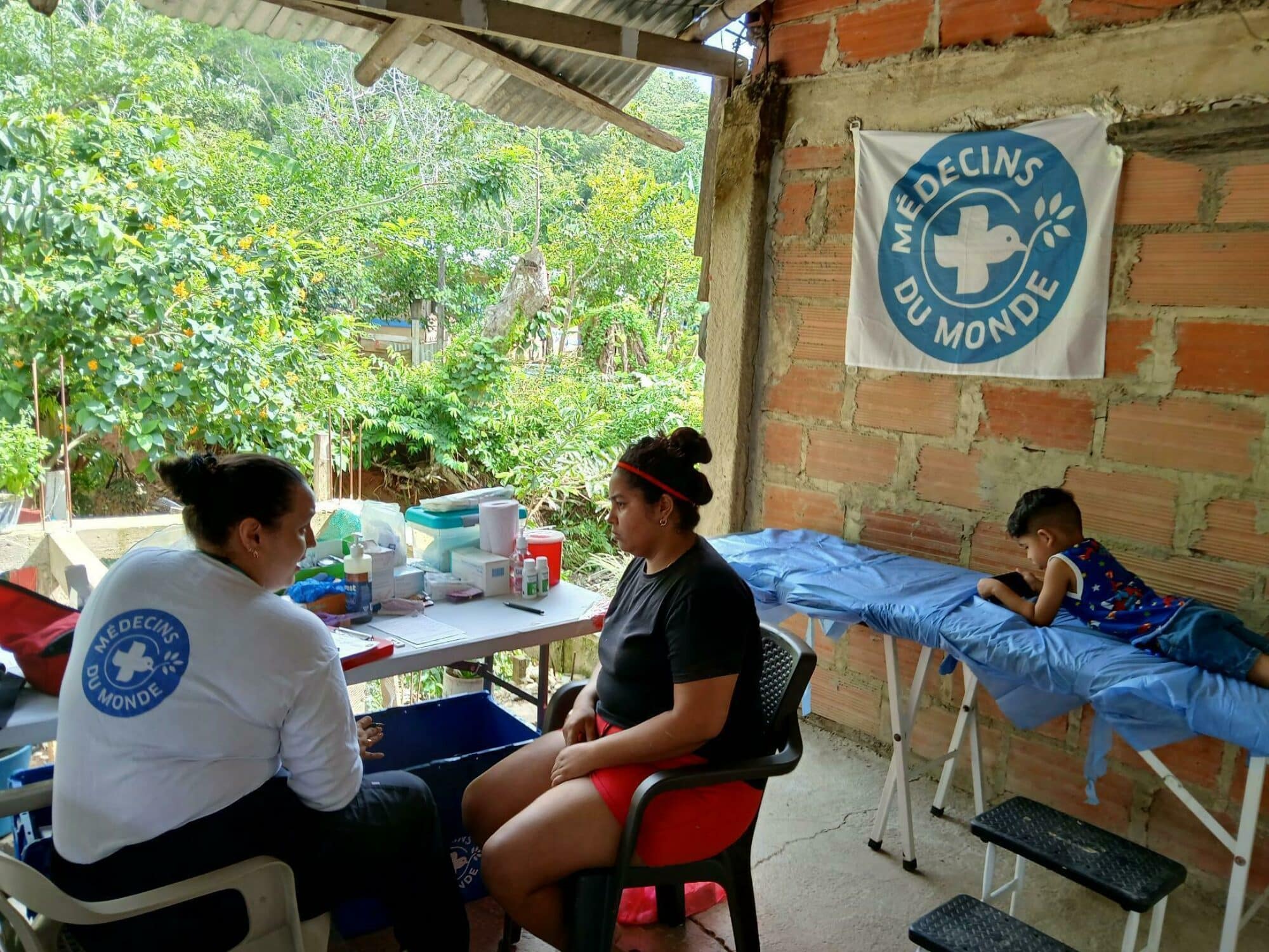
Two permanent care points have been established in Capurganá: the first at the dock, where the team provides primary health care — including sexual and reproductive health and psychosocial support — in coordination with Colombian health authorities; the second in a shelter where migrants spend the night before continuing their journey to Necoclí or Turbo.
In addition, mobile clinics have been deployed in the most hard-to-reach areas of Acandí and Capurganá, offering primary health care, sexual and reproductive health services, and mental health support — for both migrants and host communities. This approach helps expand health coverage, prevent disease outbreaks, and reach a population otherwise left behind by institutional health services.
This response is also part of a complementary approach: while other international organizations focus on protection, Médecins du Monde prioritizes primary health care and prevention, ensuring comprehensive coverage of needs throughout the migratory journey.
NAMING VIOLENCE TO PAVE THE WAY FOR DIGNITY
Beyond physical care, sometimes a simple conversation can change a life trajectory. During a mobile clinic held in December, while people were waiting to receive care, the Médecins du Monde team organized an awareness session on Gender-based violence.
Using the violentometer — a visual tool that places different behaviors on a risk scale, from yellow (“be cautious”) to red (“danger”) — participants were invited to collectively reflect on everyday situations: repeated humiliation, constant control, destruction of personal belongings. Actions often trivialized then began to reveal themselves for what they truly are: warning signs.
At the end of the exercise, a woman approached the psychological team. Years earlier, she had survived physical assault by her ex-partner. But it was by participating in this activity that she was able, for the first time, to recognize that her current relationship also involved more subtle forms of violence — which she had never been able to name until then.
Through a gender-sensitive, trauma-informed, and human rights-based approach, the team was able to support her: non-judgmental listening, validation of her experience, psychoeducation tools on the cycle of violence, and then identification of her internal resources and support networks.
For this woman, naming the violence was the first step toward reclaiming her dignity.
“This experience shows how, in a humanitarian context, a space for dialogue and attentive listening can become a turning point,” say Lesly Abuchar and Andrea Aguilar, members of the Médecins du Monde team.
A CONTINUING PRESENCE
Médecins du Monde continues to monitor the evolution of cross-border migratory flows to adapt its response, while maintaining its primary health care services in Capurganá. A needs assessment incorporating gender and intersectionality dimensions is underway, as is the deployment of new mobile clinics to reach migrants and host communities in the most remote areas of the region.
This project, carried out with the support of Global Affairs Canada, illustrates Médecins du Monde’s commitment to leaving no one behind — neither in terms of physical health nor human dignity.