
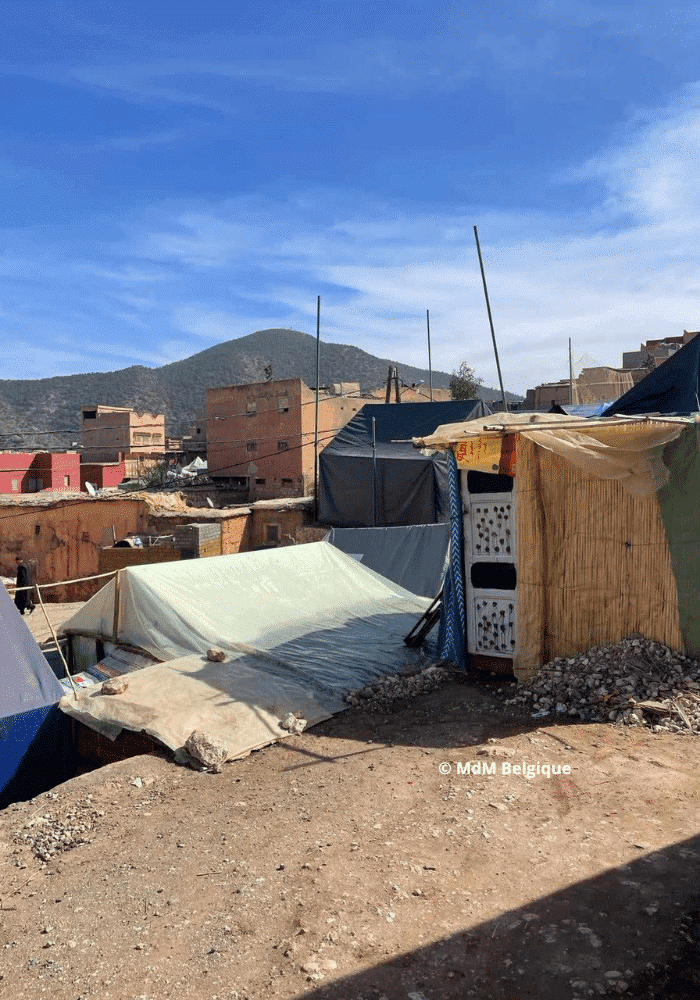
From the very first moments following the disaster—a 7-magnitude earthquake according to the Moroccan Centre for Scientific and Technical Research—Médecins du Monde organized an assessment mission. The local team was immediately reinforced by 3 people: an emergency coordinator, a mental health and psychosocial support coordinator, and a logistics coordinator.
This assessment mission quickly turned into an emergency psychosocial intervention, and the first psychological first aid was provided to affected people in the villages. A collaboration was established with local partners, including CARE Morocco.
CARE Morocco focused on covering basic needs such as distributing food and hygiene kits, while Médecins du Monde handled the psychosocial support. This support was provided by two mobile teams, made up of a total of 6 Moroccan psychologists. Medical care was the responsibility of the government from the outset.
Mental health and psychosocial support activities included individual psychological consultations and group activities, such as discussion groups, PFA (psychological first aid) interventions, and thematic workshops tailored to the needs of affected communities. These activities benefited 526 people through individual psychological consultations and 4,331 through group psychosocial activities.
At the same time, training sessions were offered to local partner organizations, particularly on mental health and psychosocial support in emergency situations.
The response continues
Today, Médecins du Monde teams remain reinforced on the ground: an intervention team of 6 national psychologists is working alongside a team responsible for coordination, logistics, and health and mental health referrals (in emergency situations). While the first phase of the intervention focused on meeting the basic needs of populations affected by the earthquake, the second phase, in 2024, aims to restore access to essential services for people in situations of vulnerability in the areas affected by the earthquake.
The earthquake highlighted the pre-existing inequalities in the intervention zone: marginalized people who were able to meet their basic needs before the disaster found themselves doubly affected by the earthquake and by intersectional factors of exclusion. People who are ill or have reduced mobility, women, infants, single-parent families headed by women, as well as sex workers, survivors of gender-based violence, people in migration situations, and other marginalized populations are particularly exposed due to their pre-existing vulnerability.
Médecins du Monde Belgium has been present in Morocco since 2013 in the Oujda and Rabat regions. It assists migrants in accessing healthcare from which they are excluded. Specific projects target migrant women and children in migration situations who are in Morocco.
|
Local partners in this project |
|
CARE (France and Morocco), ALCS (its branches in Marrakech and Taroudant), MS2, the SMPC (National Society of Clinical Psychologists), Psychologues Maghreb, as well as the administrative and health authorities. |
|
International partners in this project |
|
The Swiss Solidarity, the Crisis and Support Centre of the French Ministry of Foreign Affairs (CDCS), the Ministry of International Relations and La Francophonie of the Government of Quebec (MRIF), and Wallonia-Brussels International (WBI). |