
Bill 103, which aims to regulate supervised consumption services (SCS), introduces a cumbersome, centralized and discretionary authorization procedure that could significantly limit existing services and the opening of new centres. This process could place an excessive administrative burden on organizations that are already mobilized on the front lines, with very few resources, to prevent overdoses, provide care and save lives. Moreover, the bill provides no support measures for organizations that would be forced to relocate because of the new restrictions, which could further undermine the stability of health services already under heavy pressure.
A multifaceted public health crisis
It is worth noting that Quebec is going through an unprecedented public health crisis, marked by a rise in fatal overdoses, an increase in the number of people experiencing homelessness and growing mental health distress, compounded by a housing crisis that deprives many people of dignified and stable living conditions. In Quebec, the number of people experiencing homelessness jumped by 44% between 2018 and 2022. Over the past year, the number of deaths related to suspected opioid or other drug poisoning rose by 33%, an average of 54 deaths per month.
In terms of drug policy, Bill 103 as proposed disregards the public health guidelines supported by United Nations bodies such as the World Health Organization (WHO) and the Office of the High Commissioner for Human Rights (OHCHR), as well as those supported by other international organizations, including the Global Commission on Drug Policy (GCDP), Harm
Reduction International (HRI) and the International Drug Policy Consortium (IDPC).
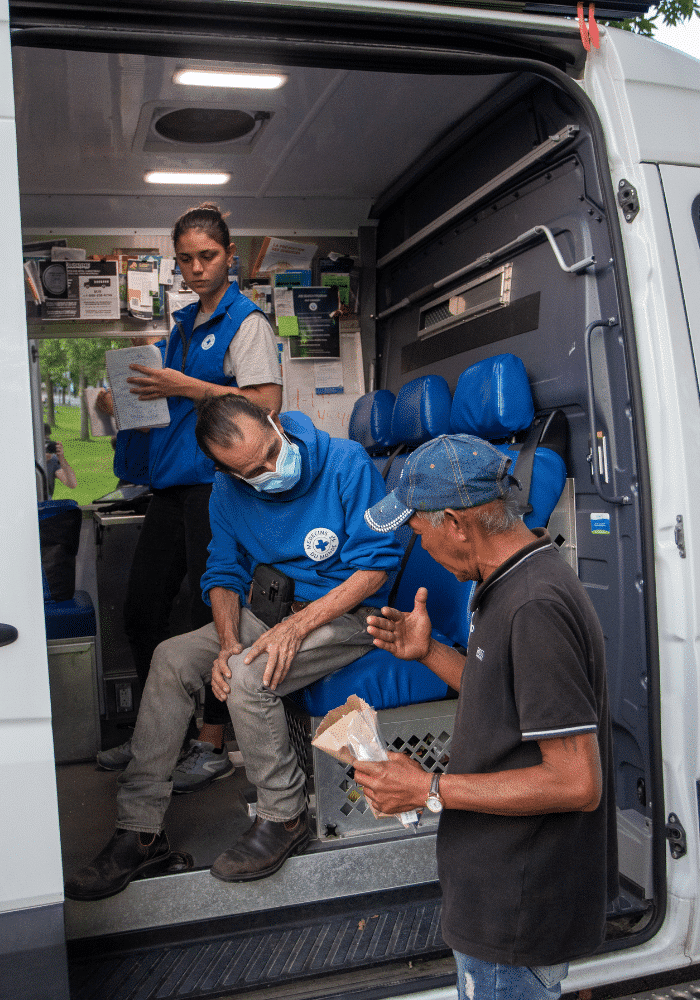
Supervised consumption centres are first and foremost health services, said Pénélope Boudreault, Director of National Operations and nurse at Doctors of the World Canada.
The essential role of supervised centres
“Supervised consumption centres are first and foremost health services, said Pénélope Boudreault, Director of National Operations and nurse at Doctors of the World Canada. Professionals also treat physical and mental health problems and provide psychosocial support, all in a supervised, safe and respectful environment. Every day, our team sees it first-hand: these centres save lives, reduce risks and harms, and build essential connections with people who have no other entry point into the health system.”
“This bill claims to establish a clinical services pathway within a continuum of care, but that pathway does not exist, especially since the network is saturated and referrals are extremely difficult, said Sandhia Vadlamudy, Executive Director of the Association des intervenants en dépendance du Québec. Supervised consumption services are often the only safe and accessible space for people left in vulnerable situations.”
In addition, these health services contribute to public safety by supporting people who use drugs, reducing visible drug use in public spaces and preventing overdoses.
This bill claims to establish a clinical services pathway within a continuum of care, but that pathway does not exist, especially since the network is saturated and referrals are extremely difficult, said Sandhia Vadlamudy, Executive Director of the Association des intervenants en dépendance du Québec
Expanding services, not restricting them
Bill 103 also gives the minister the power, by simple regulation, to impose an authorization process on places that mainly serve people experiencing homelessness. This creates legal and economic uncertainty for organizations working with these populations. Given the public health emergency Quebec is facing, it is important to ensure that Bill 103 does not limit access to essential resources for the most precarious people, which would risk deepening social inequalities and health challenges.
Rather than restricting measures that save lives, there is an urgent need to expand outreach services and support interventions that meet the real needs of the most precarious populations. It is essential that these already marginalized people not be further excluded from the health, support and accompaniment services that help improve their lives and enable better coexistence and social contribution.
Coalition members will conduct an in-depth analysis of the bill’s provisions in order to fully understand its consequences and impacts on the people concerned. They intend to take part in the special consultations on Bill 103 and call on the Minister responsible for Social Services to extend them an invitation.
About Doctors of the World Canada and the Association des intervenants en dépendance du Québec (AIDQ)
Doctors of the World Canada, AIDQ members and their partners are on the front lines of the response to the overdose and homelessness crisis. They work directly with people who use psychoactive substances, providing health services, psychosocial support and accompaniment throughout Quebec. Their expertise is built on years of fieldwork, research, program evaluation and collaboration with medical, community, academic and institutional settings, as well as with people with lived experience. They are all key players in assessing the real impact of policies on the most precarious populations.
Learn more about our harm reduction program
Media contacts:
Mélissa Cabana
Director of Communications
Doctors of the World Canada
melissa.cabana@medecinsdumonde.ca
514-799-8985
Elise Etienne (she/her)
Communications Officer – AIDQ
agcommunication@aidq.org
514-287-9625, ext. 107
Full list of organizations that signed the press release:
- L’Anonyme
- Association pour la santé publique du Québec (ASPQ)
- Association québécoise des centres d’intervention en dépendance (AQCID)
- Association des intervenants en dépendance du Québec (AIDQ)
- Association québécoise pour la promotion de la santé des personnes utilisatrices de drogues (AQPSUD)
- Bureau régional d’Action sida Outaouais (BRAS Outaouais)
- CACTUS Montréal
- Centre d’intervention et de prévention en toxicomanie de l’Outaouais (CIPTO)
- Clinique interdisciplinaire en droit social de l’Outaouais (CIDSO)
- Coalition des organismes communautaires québécois de lutte contre le sida (COCQ-SIDA)
- Collectif régional de lutte à l’itinérance en Outaouais (CRIO)
- Coopérative de solidarité SABSA
- Dopamine
- Maison Benoît Labre
- Doctors of the World Canada
- Oasis unité mobile d’intervention
- PACT de rue
- Point de Rue
- Regroupement des Auberges du coeur du Québec
- Regroupement intersectoriel des organismes communautaires de Montréal (RIOCM)
- Regroupement des organismes communautaires pour le travail de rue (ROCQTR)
- Réseau d’aide aux personnes seules et itinérantes de Montréal (RAPSIM)
- Réseau SOLIDARITÉ Itinérance du Québec
- Service de travail de rue de Chicoutimi
- Sidalys
- Spectre de rue
- Table des organismes communautaires montréalais de lutte contre le sida (TOMS)
- Tandem Mauricie