
As the epidemic spreads rapidly and health authorities and humanitarian actors work to try to contain its spread, rumours are growing and increasing the population’s resistance.
“The urgency of the situation requires quick action. But in the rush, we sometimes skip essential steps. Taking the time to dialogue with affected communities and listen to their concerns and directions is crucial if we want to ensure ownership and acceptance of Ebola control measures by the population,” explains Oscar Bahiva Ayagirwe, community health focal point for Médecins du Monde in South Kivu.
DISTRUST TOWARDS RESPONSE ACTORS
Tents burned, stone-throwing, attempts to forcibly extract the bodies of some deceased patients, etc. In recent weeks, several violent incidents have occurred near Ebola treatment centres in Ituri province, reflecting the population’s mistrust of the measures implemented to combat the epidemic.
“With every Ebola epidemic, there are rumours circulating; it is far from a new phenomenon. But rumours are each time fuelled by the specific context,” says Oscar B. Ayagirwe. “The major economic crisis in eastern DRC – already plagued by chronic conflicts – strongly influences current local perceptions. Some people believe that Ebola is an invention by health workers and humanitarian actors to make money, especially since international NGOs keep complaining about the lack of funding.”
CO-CONSTRUCTING THE RESPONSE
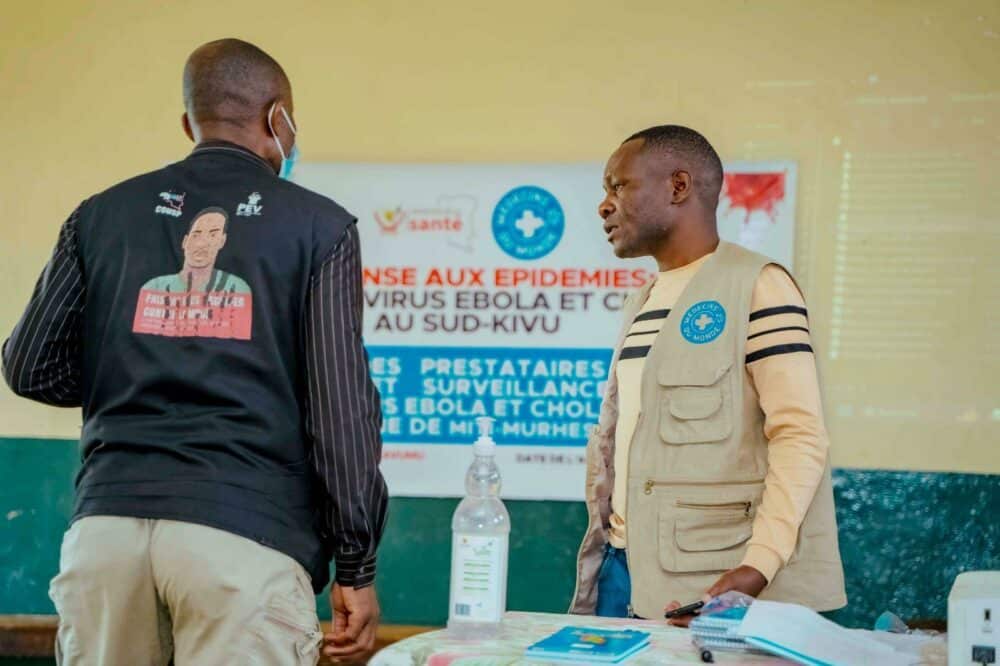
While the epicentre of the epidemic remains contained in Ituri for now, the provinces of North and South Kivu are seeing the number of cases rise day by day. On the ground, Médecins du Monde teams are working closely with healthcare providers, civil society organisations, and community outreach workers to strengthen risk communication and community engagement (RCCE).
RCCE is a fundamental cross-cutting pillar of the response to an Ebola epidemic, as it allows the dissemination of reliable, accurate, and real-time information within the population. It is a highly effective means of (re)building trust between communities and response actors, combating misinformation, and promoting the rapid detection of patients with suspicious symptoms.
“Local communities know their environment better than we do. That is why we must avoid arriving with ready-made messages and solutions, and give the population the opportunity to co-construct an adapted intervention,” insists Oscar B. Ayagirwe.
In Ibanda or Katana, for example, two health zones in South Kivu located near Lake Kivu and thus with a significant flow of travellers, Médecins du Monde teams emphasise the need for vigilance regarding population movements, particularly from areas heavily affected by the epidemic. In contrast, in an area like Miti-Murhesa, bordering Kahuzi Biega National Park, communication focuses more on the risks associated with consuming bushmeat (one of the disease’s transmission vectors).
EVERYONE ENGAGED
Since last week, in collaboration with local health authorities, 300 community outreach workers have already been trained by Médecins du Monde in several health zones in Bukavu and surrounding areas, where the first Ebola cases were recorded in South Kivu. With the ongoing support of Médecins du Monde teams, each trained individual is now responsible for raising awareness among 50 to 70 households in their community.
“The goal is to reach as many people as possible, as quickly as possible. This way, everyone feels concerned and can act at their level. The fight against the epidemic is not only the responsibility of ‘experts.’ Everyone is responsible for looking out for their family, neighbours, and community,” concludes Oscar B. Ayagirwe.