
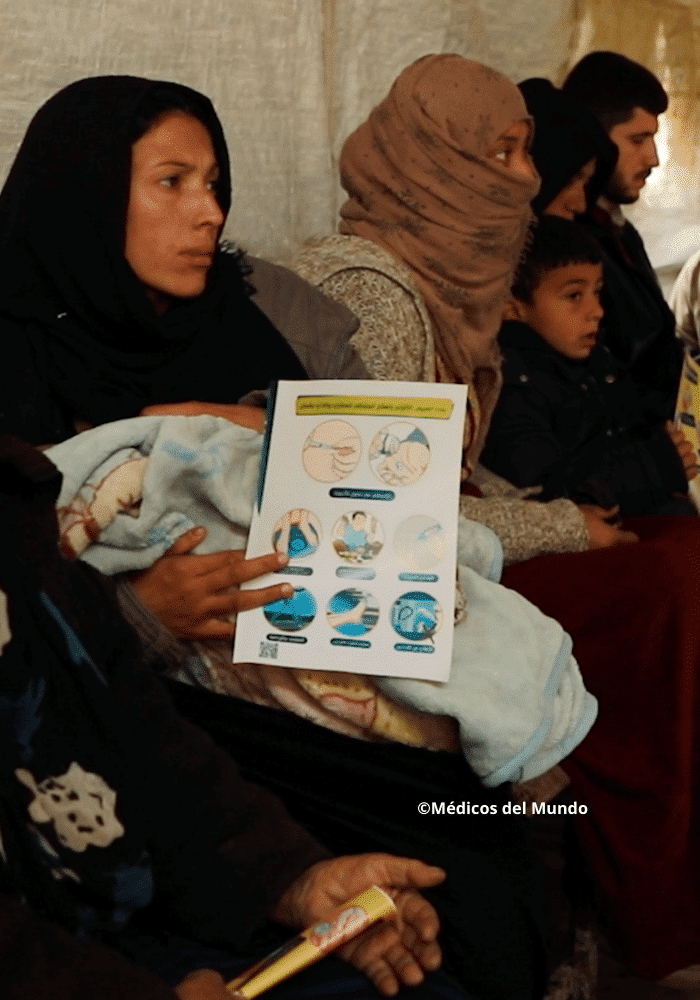
Since 2017, Médecins du Monde has been working in northeastern Syria and is calling for attention to be focused on this country, which only manages to cover 36% of the funding for its humanitarian health needs.
The Syrian people are struggling with a weakened health system: private consultations are unaffordable, and the public system is severely overstretched. According to the World Health Organization (WHO), only 59% of hospitals and 57% of primary health care centers are fully operational in Syria. Their functioning relies heavily on NGOs. Primary health care centers that do not receive support from humanitarian organizations often lack healthcare staff, equipment, and quality standards.
Furthermore, in northeastern Syria, vaccine shortages are contributing to the emergence of outbreaks and epidemics. The significant and repeated increases in the prices of medicines and pharmaceutical products by the Syrian government and private pharmaceutical companies over the past two years.
“It’s a crime to buy medicine; it’s a crime. A doctor’s consultation costs 40,000 Syrian pounds. Today, I have nothing to buy my medicine,” says Ahmad Al Sali, a patient at the Kalasa health center in northeastern Syria.
A decade of conflict has forced many professionals to flee the country, leaving health centers and hospitals understaffed, particularly specialists such as midwives.
“The lack of midwives has been and continues to be a major constraint in our work on sexual and reproductive rights. In some places, we are forced to hire uncertified midwives (nurses with basic training in sexual and reproductive health) because it is difficult to find qualified candidates. Sometimes, the recruitment process lasts several months without successfully hiring a single midwife,” explains Ejaz Ahmed, Médecins du Monde’s coordinator in northeastern Syria.
Another public health challenge in the region is awareness and the surge of epidemics (such as seasonal leishmaniasis, cholera, measles, acute respiratory infections, and diarrhea, among others) and malnutrition, which result from precarious living and health conditions, exacerbated by the current conflict situation.
Additionally, we warn about the high levels of malnutrition among women of reproductive age and children in northeastern Syria. Regions such as Deir-ez-Zor, Al Hasakeh, and Ar-Raqqa report catastrophic rates of stunting exceeding 30%. Moreover, one in four women aged 15 to 49 suffers from anemia, with an even higher prevalence among adolescent girls, where one in two is anemic.
Syrians live in a state of post-traumatic stress
To be healthy, one must not only address physical health but also, and to a large extent, mental health, which is crucial after 13 years of conflict. Due to the ongoing conflict, the fragility of the security situation increases chronic illnesses and mental and psychosocial health disorders.
“Generally speaking, the entire society suffers from post-traumatic stress syndrome. And this has consequences: anxiety, stress, depression, etc. As psychology professionals, we don’t know how long this can last. It could last 10 years or even longer,” explains Ramadan Derwish, a psychologist at the health center in Kobané.
Médecins du Monde is one of the few actors on the ground working on mental health from one health center to another and from house to house: raising awareness in communities and providing mental health and psychosocial support teams within the public health system.
What is life like in northeastern Syria after 13 years of war?
People’s main concern is putting food on the table, sometimes even more than security. Going to the market or paying for a medical consultation has become almost a luxury due to the high inflation of the past three years (650% since 2020), which has severely worsened the economic situation.
Furthermore, in recent months, the region has witnessed an escalation of attacks by Turkey against critical infrastructure such as oil refineries, water supply points, electricity networks, and other key facilities, including health centers, directly affecting the most basic livelihoods of the population: over a million residents of eleven major cities, as well as more than 2,750 villages in the region, are now completely without electricity. Additionally, the price of gas has increased tenfold.
The scarcity of water has led to an increase in waterborne diseases. Health centers in the region report a rising trend in cases of acute diarrhea, reflecting the inadequacy of water supply, sanitation, and hygiene services.
After 13 years of conflict, humanitarian response funding is not meeting the needs of the Syrian people. According to OCHA data, by the end of 2023, the required funding for the health component of the Humanitarian Response Plan was only 36% covered, and just 24% for nutrition. Donations for Syria have further declined due to other regional crises. There is an urgent need for adequate funding to ensure health and nutrition support.
Médecins du Monde in Syria
Médecins du Monde has been working with the public health system in northeastern Syria since 2017 to provide vital services and build a resilient system in which local authorities can gradually take responsibility for health. From rebuilding health centers to equipping and staffing them, Médecins du Monde works on physical and mental health through primary care, specialized consultations, sexual and reproductive health care, and mental health and psychosocial support. The organization also provides the health system with free access to medicines.
Another important aspect of Médecins du Monde’s health work involves awareness-raising and home visits to educate the population, technical support for training and supervising Syrian health workers, and responding to emergencies such as last year’s earthquake, cholera outbreaks, and the COVID-19 pandemic.
In 2023, Médecins du Monde reached
- over 600,000 people
- with more than 1.2 million consultations.