
A Forgotten Crisis and a Health System in Peril
Fifteen years after the earthquake, Haiti is facing a spiral of ongoing violence that compounds the multiple health, humanitarian, and security challenges plaguing the country. More than 5,600 people were killed in 2024 due to the surge in violence, according to the UN—a rise of over 1,000 compared to the total number of people killed in 2023.
“The January 2010 earthquake struck a healthcare system that was already far from optimal. Over the past two years, institutions have been under attack and are unable to function properly. A large portion of the population struggles to access healthcare,” notes the medical coordinator for Médecins du Monde in Haiti.
The public system suffers from chronic underfunding, a shortage of resources, and a critical lack of staff. Currently, only 37% of healthcare facilities in Port-au-Prince are fully operational and remain difficult to access due to insecurity, according to the UN. Over 40,000 healthcare workers have fled the country because of the violence, as reported by the United Nations Integrated Office in Haiti (BINUH). Most private facilities have closed, and many victims cannot afford their services. Healthcare staff, patients, and institutions are being targeted, a situation firmly condemned by Médecins du Monde. The international community’s response remains insufficient to address the urgency of the situation and the collapse of the healthcare system.
When someone has knee pain, the pain is sharp at first—it immediately grabs their attention. They will seek care quickly to relieve the suffering. But if the pain persists for a long time, the person starts living with it; it becomes a habit, it no longer captures their attention—and that’s a bit like the situation in the country,” said the medical coordinator for Médecins du Monde in Haiti.
Haiti is experiencing a crisis that continues to worsen day by day and has ultimately been forgotten by the rest of the world, even as 5.5 million people require humanitarian aid and the needs are both complex and urgent.
“We want the system to be able to function on its own, which is why we support it. When we see what we’ve been able to do with our resources, the population is already very grateful—it’s worth continuing. Resilience is an emblematic quality of the Haitian people. We witnessed it on January 12, 2010, when people who had lost everything helped each other, shared what they had, and continued to live and smile.” – Medical coordinator for Médecins du Monde in Haiti.
Responding to the Emergency Through Well-Established Community Ties
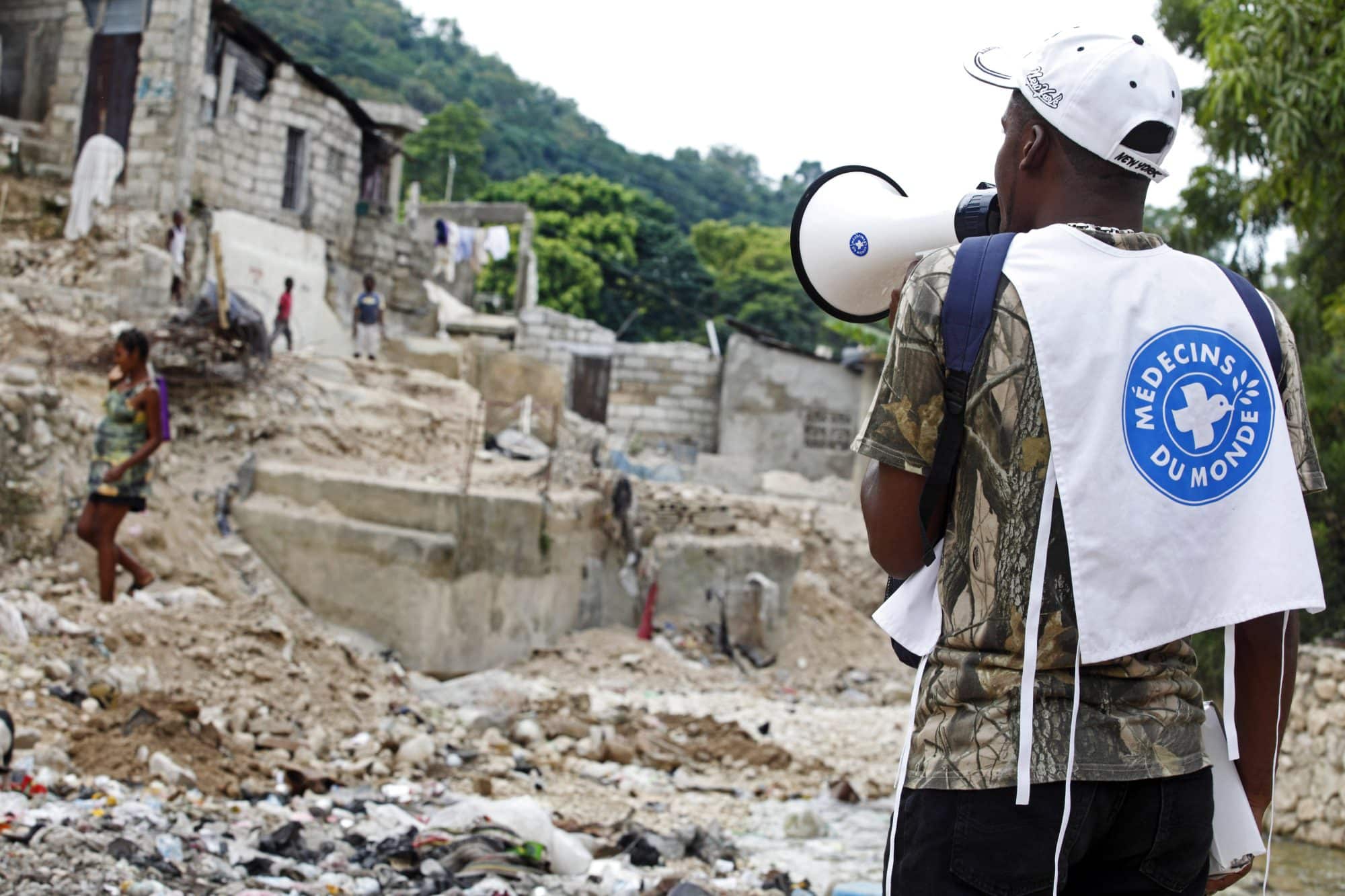
Present in Haiti since 1996, Médecins du Monde was already supporting health services long before the earthquake on January 12, 2010. This deep-rooted community presence enabled local teams to act immediately to address the urgent needs of the population in the Port-au-Prince area, the capital, which was severely affected by the disaster.
“When the ground shook, I was working as a general practitioner in Port-au-Prince. It was in the context of the post-earthquake response in 2010 that I joined Médecins du Monde. Even before this disaster, the organization was already supporting health services in Cité Soleil through programs to combat HIV/AIDS, malnutrition, and maternal and child health, while conducting community awareness activities. This close connection with the community facilitated the rapid deployment of mobile clinics, benefiting not only displaced persons living in camps but also residents of adjacent neighborhoods, who were often deprived of access to care even before the earthquake.” – Medical coordinator for Médecins du Monde in Haiti.
After the January 12 earthquake, Médecins du Monde set up a semi-permanent clinic in a displacement camp, along with mobile clinics serving eight camps and several neighborhoods in Cité Soleil. In addition to medical care, displaced populations received mental health and psychosocial support to address the invisible wounds of the disaster. Emergency and reconstruction interventions continued until 2012, before shifting focus to strengthening existing health centers in collaboration with public institutions, health authorities, and local communities.
Continuing the Fight Against Cholera
In October 2010, a cholera epidemic broke out along the Artibonite River in Haiti. This acute intestinal infection, introduced by Nepalese soldiers from the United Nations Stabilization Mission in Haiti (MINUSTAH), was responsible for the deaths of 9,792 Haitians between 2010 and 2019, according to estimates from the Haitian Ministry of Public Health and Population (MSPP). For 10 years, Médecins du Monde, in collaboration with authorities and other partners and thanks to its community presence, fought against the spread of the disease. Its actions included setting up 19 oral rehydration stations, a treatment unit in Cité Soleil, and rapid response mobile teams (EMIRA), treating nearly 10,000 people, and raising awareness among over 141,000 individuals. Subsequently, Médecins du Monde’s interventions against the epidemic expanded to the entire metropolitan region of Port-au-Prince and the Northwest department. In 2022, during an official ceremony marking the elimination of cholera in Haiti, the efforts of Médecins du Monde’s team were commended by the Prime Minister and the Minister of Public Health and Population.
In October 2022, a cholera epidemic resurfaced in Haiti after nearly three years without cases, spreading rapidly across the country. Insecurity, fuel shortages, and difficulties accessing care worsened the situation, leading to a resurgence in six departments. Although under control, the situation remains conducive to the spread of cholera and other diseases such as dengue, tuberculosis, measles, and polio, particularly in displacement sites. Médecins du Monde reaffirmed its commitment by responding quickly to the needs of affected communities.
With all the challenges facing the Haitian population, Médecins du Monde is calling for your generosity to continue providing physical and mental healthcare to the most vulnerable individuals and communities in this multifaceted crisis.
Médecins du Monde in Haiti
Present in Haiti for nearly 30 years, Médecins du Monde works in the fields of health, sexual and reproductive health and rights, mental health, protection, and capacity-building for healthcare staff and infrastructure. In collaboration with community health workers (ASCP), health authorities, and its partners, the organization addresses the health needs of local communities and facilitates their access to care, despite a complex security context.
Photo: Lahcene Abib