
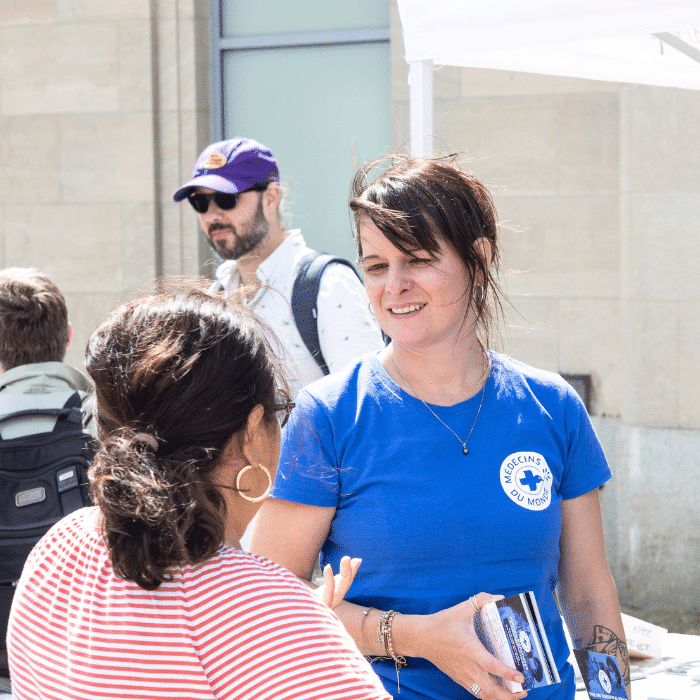
“Sitting with the world makes us familiar and trustworthy.”
Presence and trust: care before care
“To eventually talk about care with the person, you first have to talk about the rest and be present in other moments of their life.”: that is what Mathieu, an Indigenous navigator, shares. It was no surprise, then, when he added that his favourite intervention tool was humour. His eyes sparkle as he elaborates: “laughter is also care.” Farin, a peer support worker in harm reduction, does not disagree: “sitting with people makes us familiar and trustworthy.” Farin works in Médecins du Monde’s mobile clinic alongside Andréanne, a nurse. Their duo places trust at the heart of their practice, which includes “caring about the person’s circle,” as Andréanne tells us. “When Farin talks with friends of the person he is supporting, he always asks: and you, how are you? how are you experiencing all of this?”
Caring for the community: indirect care
The circle remains a relay too often overlooked in the modern approach to health: “care is not just about providing a solution to a problem, it is about taking into account everything around it,” explains Mathieu. He sums it up: “a healthy person is a healthy community.”
“A roof, food, advocacy…: this support is also part of care.”
Working in community: care as a collaborative practice
Through the interviews, it quickly becomes clear that “the community” also refers to all the health professionals with whom Farin, Mathieu, Andréanne and others collaborate. In the hospital, for example, these are “the doctors and nurses we educate about the person’s reality, their perception of institutions,” as Farin describes. Juliette, who supervises Médecins du Monde’s outreach team, extends the ties that weave this community to include workers focusing on a “more social aspect: a roof, food, advocacy…: this support is also part of care.”
And if care were first and foremost a bond? A bond of trust built through laughter, listening, time spent together, and kind collaboration… A bond that helps break down barriers to care without judgment.