
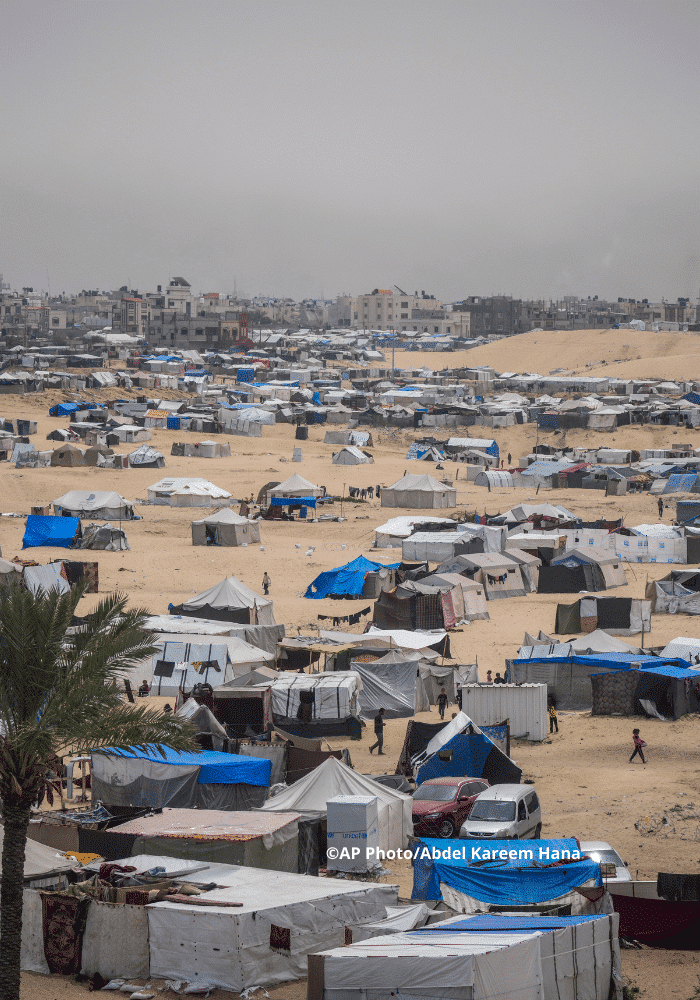
More than 1.5 million people, including 600,000 children, are gravely threatened; over 450,000 Palestinians have fled Rafah since Israel issued illegal “evacuation orders” on May 6. As the Israeli army has already taken control of urban areas within Rafah, the issuance of new “evacuation orders” on May 11 sets the stage for a further advance of the military invasion, which will lead to the total collapse of vital services. The Israeli military offensive has disrupted aid access to Gaza through the Rafah and Kerem Shalom/Karm Abu Salem crossing points.
Third states have the responsibility to act urgently to end the serious violations of international humanitarian law (IHL) committed in Gaza, and perpetrators must be held accountable. The first step third states must take to fulfill their own legal obligations and ensure respect for IHL is to halt the invasion of Rafah, open all land crossing points, and remove internal barriers to allow humanitarian aid access. As the primary arms supplier for Israel’s military effort, the United States bears significant responsibility for Israel’s IHL violations. Beyond halting the transfer of certain bombs, the United States must also use all its influence to end the ongoing military operation in Rafah. All arms suppliers must comply with the Human Rights Council resolution adopted on April 5, which calls on them to cease the sale, transfer, and diversion of arms, ammunition, and other military equipment to Israel. All states must act now to secure an immediate and lasting ceasefire.
Israel’s military “evacuation orders” are illegal and constitute forced transfer, a serious violation of IHL. Israel has ordered hundreds of thousands of Palestinians to flee without providing civilians and humanitarian actors with clear information or timelines. IHL sets precise conditions for an evacuation to be lawful: the occupying power must ensure that such displacements are temporary and that displaced persons enjoy satisfactory conditions of hygiene, health, safety, and nutrition, and family members must not be separated. Israeli authorities are failing to meet any of these requirements. Already overwhelmed by multiple displacements, Rafah’s residents must once again flee amid destroyed infrastructure and streets contaminated with unexploded ordnance. Displaced individuals are seeking refuge in Deir Al Balah and Khan Younis, including Al Mawasi, despite extensive destruction and a lack of everything necessary for survival. The concept of “safe humanitarian zones” is void, as areas previously designated as such have been targeted by bombings and ground operations. While relentless bombings continue in Rafah, airstrikes and ground assaults are intensifying in the north, leading to further forced displacements within the enclave.
The Israeli military invasion of Rafah is destabilizing the humanitarian response, in violation of UN Security Council resolutions 2720 and 2728, as well as the International Court of Justice’s provisional measures ordering Israel to allow the provision of basic services and humanitarian aid. Due to Israeli military activity in the northern governorates in recent months, humanitarian actors have been forced to relocate much of their aid capacity to Rafah, including their facilities and warehouses. The Israeli offensive is already forcing some humanitarian staff and operations to close or relocate to other areas under extremely dangerous conditions. Warehouses containing vital aid in eastern Rafah remain inaccessible due to the presence of Israeli forces. Medical facilities in Rafah are shutting down one after another¹.
Every hour that Israeli forces occupy the Rafah and Kerem Shalom/Karm Abu Salem crossing points condemns more Palestinians to starvation and denial of medical care. Israeli forces are completely preventing humanitarian aid and personnel from using the Rafah crossing. The heavy militarization around the Kerem Shalom/Karm Abu Salem crossing resulting from the Israeli ground invasion does not provide the necessary conditions for the safe and sustained movement of humanitarian convoys. These two crossing points are the main lifeline for aid entering the enclave: their closure plunges Gaza into an even more disastrous humanitarian catastrophe. While the World Food Programme has confirmed famine conditions in northern Gaza and the health system is collapsing, stocks of essential aid, including food, water, fuel, and medical supplies, are rapidly depleting. This situation has already led to the closure of services essential for civilian survival². The extremely limited reopening of northern crossing points or the prospect of a maritime route cannot justify reducing access through southern land crossing points.
Fuel depletion risks interrupting humanitarian operations and basic services. The entire humanitarian response depends on fuel, particularly to address the priority needs of over 1.7 million displaced persons. Urgent priority must be given to the immediate supply of fuel to support what remains of Gaza’s devastated health system and humanitarian action³.
SIGNATORIES:
- ActionAid
- Action Against Hunger
- American Friends Service Committee (AFSC)
- Amnesty International
- A.M. Qattan Foundation
- Anera
- Churches for Middle East Peace (CMEP)
- DanChurch Aid (DCA)
- Humanity & Inclusion/ Handicap International (HI)
- IM Swedish Development Partner
- INTERSOS
- Médecins du Monde International Network
- Mennonite Central Committee
- Mercy Corps
- Norwegian People’s Aid
- Oxfam
- Plan International
- Norwegian Church Aid (NCA)
- Norwegian People’s Aid
- Relief International
- War Child Alliance
¹ Al Najjar Hospital, the largest health facility in the governorate, ceased operations as it is located in the area seized by Israeli forces, and Al Kuwaiti Hospital is likely to follow as it is now included in the zone threatened by Israeli “evacuation orders.”
² Eight out of the twelve bakeries in Southern Gaza, and more throughout the enclave, are at risk of shutting down due to the lack of supplies and fuel. Medical evacuations have abruptly halted, directly condemning critical patients, including children, to death.
³ Of particular concern, at least 10 hospitals, 8 bakeries, 28 ambulances, 23 medical points, and 17 primary health care centers could stop operating if fuel is not urgently allowed into the enclave. The lives of babies in intensive care, women with complicated pregnancies and births, and trauma patients hang in the balance. The severe fuel shortage also endangers telecommunications, which is already negatively impacting humanitarian operations in Gaza.