
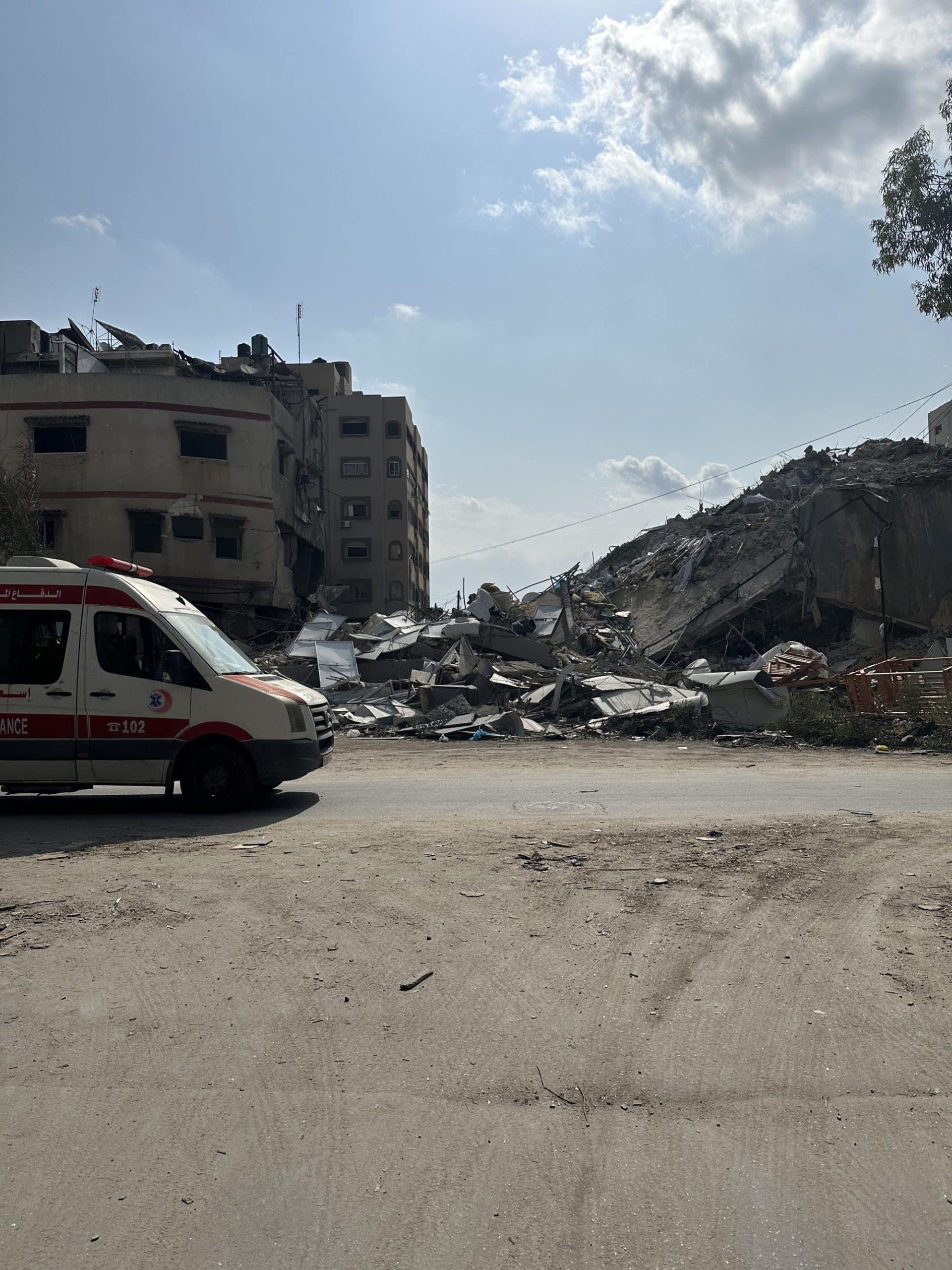
Patients, civilians and healthcare workers targeted
Since 9 November, Israeli bombings around hospitals in northern Gaza have intensified, with many of them being directly hit by airstrikes. These attacks have killed healthcare workers and caused severe damage
to the intensive care units of Al Quds Hospital as well as the
maternity ward, the oxygen supply system, water tanks,
the cardiovascular centre and part of the surgery department
at Al Shifa Hospital.
Hospitals have also been encircled by ground attacks. Sources cited by the World Health Organization (WHO) have reported cases of shooting at civilians, patients and staff members
as they attempted to flee hospital premises. Fearing to
leave or being physically unable to do so, civilians were
sieged in hospitals, without food, water or electricity.
As of 13 November, approximately 600 hospitalised patients, over 200
staff members and 1,500 internally displaced persons were trapped inside
Al Shifa Hospital, the largest medical facility
in the enclave and a shelter for tens of thousands of
people. Reports also indicate that patients and healthcare workers were targeted by snipers while inside healthcare facilities.
Bodies are decomposing in the courtyard of Al Shifa as the relentless attacks on the hospital prevent staff from burying them, thereby increasing the serious risks of infectious disease outbreaks near Gaza’s largest healthcare facility.
Spare and protect patients, medical staff and all civilians
The Israeli government justifies attacks on healthcare
facilities by claiming they are allegedly used by Palestinian
armed groups to shield military objectives. While
civilian infrastructure must never be used as a shield to protect
military objectives, this does not relieve the attacking party of its
obligation to consider the risk to civilians. Under International
Humanitarian Law (IHL), hospitals and medical staff are granted
special protection, and all parties to the conflict must take all necessary precautions and measures
to spare and protect patients, medical staff and
all civilians. Israeli evacuation orders targeting
hospitals cannot be considered appropriate precautions.
Indeed, the WHO has warned that evacuating healthcare facilities
would be a “death sentence” for patients, given the collapse of the
medical system and the overcrowding of hospitals in southern Gaza.
Healthcare for the civilian population is already severely affected by the shortage of medical supplies and power outages
caused by the total siege imposed by the Israeli government for
a month. These severe attacks, combined with the depletion of
fuel reserves for backup generators, have led to the closure of all hospitals in northern Gaza except one.
As generators in several hospitals have stopped working in
recent days, the lives of patients requiring life-support
devices are immediately at risk.
Since 11 November, 32 patients at Al Shifa Hospital,
including premature babies, have died when their life-support systems
were cut off due to the lack of electricity.
The collapse of major hospitals places an already vulnerable civilian
population at extreme risk, with immense needs for vital healthcare
likely to increase in a context of widespread consumption of unsafe water, dropping temperatures and upcoming heavy rains.
For a strong and effective diplomatic response
The attacks on hospitals we are witnessing must stop immediately. The international community cannot remain passive
in the face of bombed hospitals and killed patients. The lack of a
strong and effective diplomatic response to the atrocities committed in Gaza constitutes a failure by states to fulfil their obligations to ensure respect for IHL.
Médecins du Monde reiterates its call to all states to exert maximum pressure on the warring parties to secure an immediate ceasefire,
along with full, safe and unhindered humanitarian access, as well as
the restoration of basic supplies by the Israeli government.