
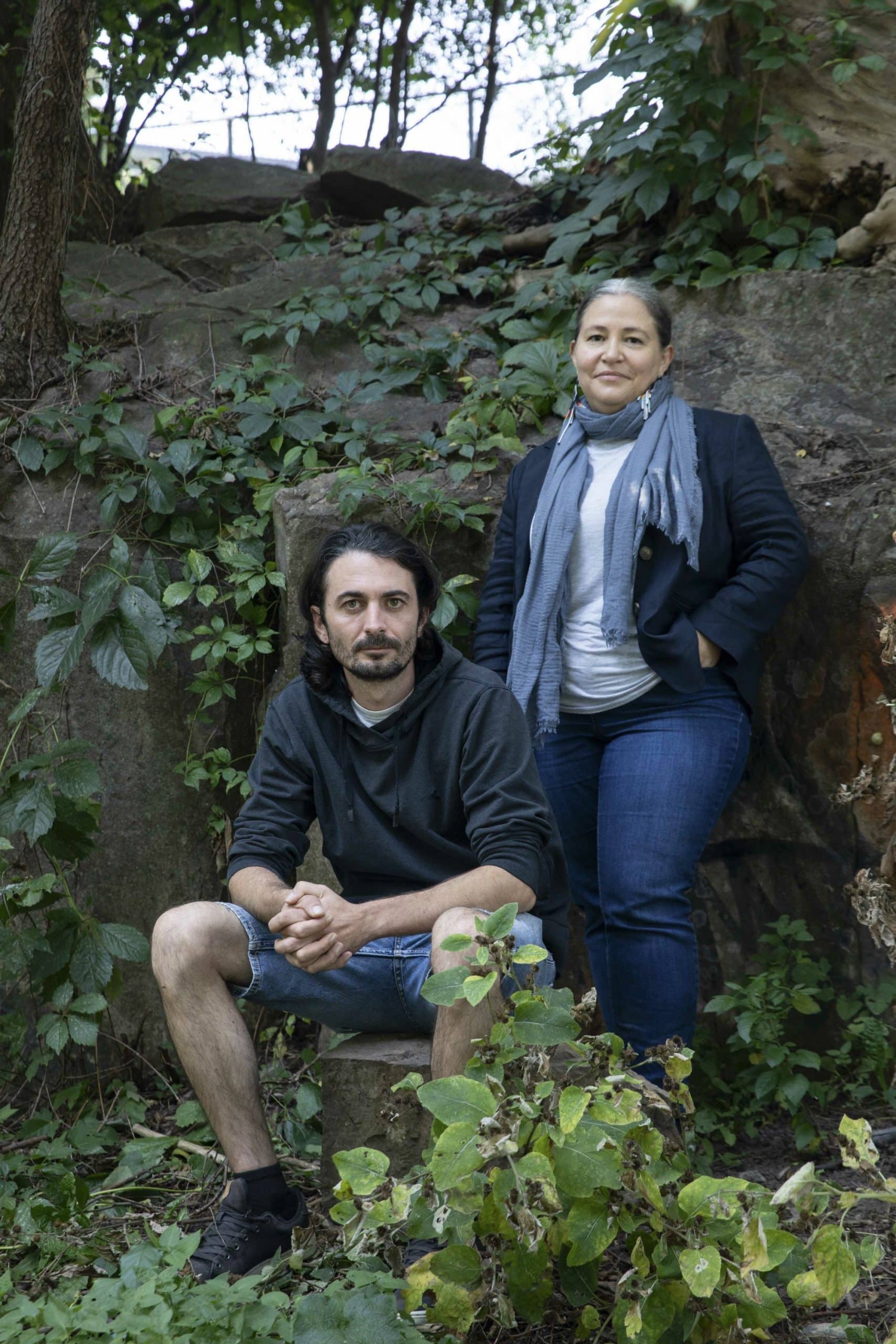
“In our families, we always had our uncles, our aunts, our cousins who would tell us ‘at the hospital they did this to me, that, I was in pain, they told me to be quiet’. We all know these stories,” Lucie-Catherine says softly.
When the nurse, born to a white father and an Anishinaabe mother, utters these words, Mathieu nods in approval. He is an Indigenous navigator; his mother is from Mashteuiatsh, an Innu community in Lac-Saint-Jean. Both work for Médecins du Monde.
The duo supports Indigenous persons experiencing homelessness to help them navigate Quebec’s health system and overcome the systemic barriers that hinder their access to care. To do this, Lucie-Catherine and Mathieu draw on their common ground. “Both of us have a foot in each culture,” the navigator explains. “It helps us see things through both lenses: the Indigenous paradigm and the white paradigm.”
This cultural background allows the nurse and the navigator to create a sense of community with their patients. It fosters a relationship of trust, which alone makes equitable and adapted access to care possible for a population that, over the course of history, has developed a deep mistrust of the health system.
That’s why, in Mathieu and Lucie-Catherine’s view, their role goes far beyond the medical act. Going for pizza after a hospital treatment and taking the time to ask how it went; exchanging a few words on a street corner; greeting familiar faces they come across: “That’s also part of care,” Mathieu asserts. Sometimes, a simple presence is enough: “Just being there. It makes all the difference.”
It’s the same for the nurse. Lucie-Catherine smiles as she thinks of a patient: “Often, she comes and doesn’t speak. Then, at some point, she stands up and says: ‘I just need a hug.’ So I give her a hug, and she leaves, thanking me for being there.”
This vision of care contrasts sharply with the one that has taken hold in the West. On one hand, health is seen as a holistic approach that goes beyond the medical act alone. On the other, a ‘problem/solution mode’ is favoured. Yet, “care isn’t about that,” Mathieu insists. As the navigator learned from his Elders, “when you go to gather a plant to heal yourself, setting out to find it is part of the medicine; the way you pick the plant is part of the medicine; the way you drink it… all of that is part of care.”
Another “basic element of [their] culture” that guides Lucie-Catherine and Mathieu is humour. “Laughing is already a form of care,” Mathieu explains. “My main intervention tool is laughing with people.” An essential ingredient that, according to the nurse, “completely eludes the Western conception of care.” Yet, it’s what allows them to “maintain the connection” with their patients. Lucie-Catherine shares: “We run into them on the street, we chat with them. It’s almost like family.” Because, in the end, “a healthy person is a healthy community.”