
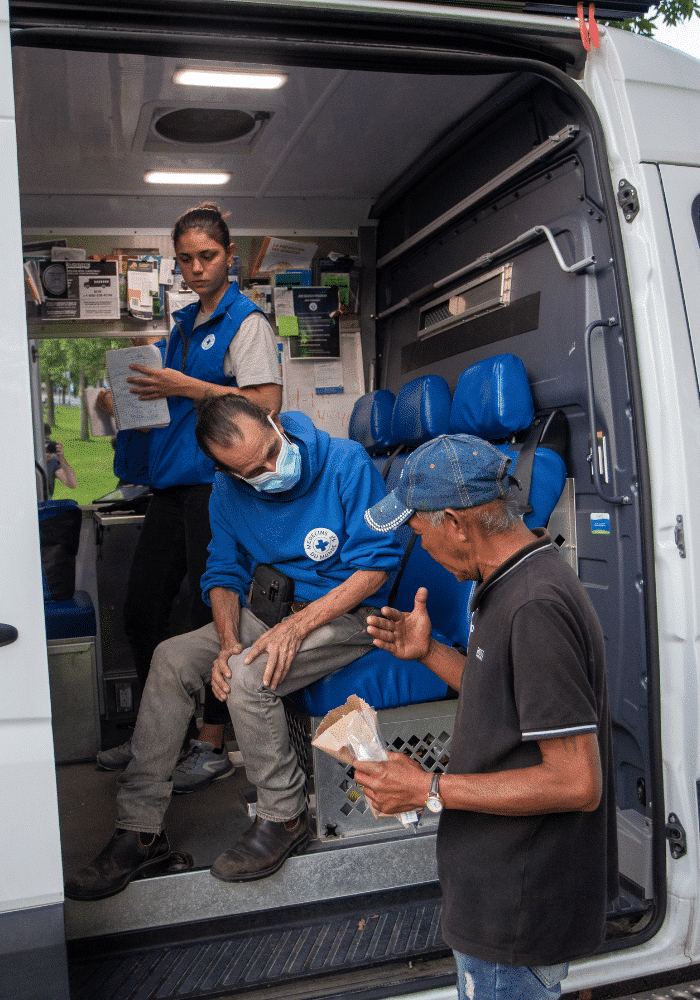
MONTREAL, June 4, 2024 – June marks the 10th anniversary of Médecins du Monde Canada’s Mobile Clinic, which travels the streets of Montreal to provide dignified and adapted health care to marginalized individuals, people experiencing homelessness or at risk of becoming so. This is a bittersweet celebration, as it also highlights the multiple barriers to care faced by a growing homeless population, whose needs have never been more pressing.
Médecins du Monde teams have been working on the streets of the metropolis since 1999; they regularly witness the worsening precariousness and deteriorating living conditions on the streets. Between 2018 and 2022, the number of people experiencing visible homelessness increased by 33% in Montreal and by 44% across Quebec. At least 10,000 people are in this situation across the province, nearly half of them in Montreal, though the actual number is certainly much higher.
“The homelessness crisis is a major public health issue, as it exposes people to extremely precarious living conditions, making them more vulnerable to infections, injuries, mental health disorders, and poorly controlled chronic diseases,” said Dr. David-Martin Milot, President of Médecins du Monde Canada and a public health specialist. To address these health problems, but more importantly, to provide real and lasting support to these individuals, Médecins du Monde places them at the heart of its interventions and adapts to their reality. This is why the mobile clinic has been successful for 10 years. It brings compassionate care to where people in need are, outside of a system that is too rigid for them. To effectively respond to this crisis, it is imperative that the health and social services network, supported by government leadership, adapt its approach to the complex reality of the streets.”
Invisible on the streets despite themselves
This homelessness crisis is intertwined with the overdose crisis and the difficulties in accessing decent housing. According to the Institut national de santé publique du Québec (INSPQ), the homeless population is overrepresented among individuals who have experienced an unintentional opioid overdose in the past six months in Quebec. Additionally, the profiles of those affected are diversifying. For example, entire families, asylum seekers or migrants, now find themselves without housing. The specific needs of the most vulnerable groups, such as women and individuals from Indigenous, migrant, and/or LGBTQ2S+ communities, are overlooked and left without adequate responses.
Both a cause and symptom of a health and social crisis, this situation stems in part from government policies that are poorly adapted to the realities on the ground and the actual needs of these individuals, thus failing to guarantee the respect of fundamental rights enjoyed by the majority of Quebec’s population, such as health, safety, and housing.
A bridge between the streets, the community sector, and the health system
Marginalized individuals face multiple obstacles in accessing health care. They often avoid hospitals out of fear of being judged, and the way Quebec’s health system delivers care is frequently not adapted to the realities of street life. The Médecins du Monde Mobile Clinic team is multidisciplinary and can address health issues holistically. Peer support workers in harm reduction, as well as Indigenous navigators, use their experiential knowledge to build connections and reach populations that are often inaccessible to the health system.
For the past decade, the Mobile Clinic has contributed to a vast network involving multiple stakeholders from both the community sector and the health system.
“With the Mobile Clinic, we go to the people to provide care that is adapted, humane, and respects their pace,” explained Pénélope Boudreault, Director of National Operations and a nurse at Médecins du Monde Canada. “We have the opportunity to be creative, to care differently. We can bear witness to the realities on the ground that the health system overlooks. Médecins du Monde does not want to replace the system but to work alongside it, as an additional link in Quebec’s health care chain.”
For a more inclusive and accessible health system
Médecins du Monde emphasizes the importance of implementing a comprehensive health approach, focused on proximity and involving the people it targets, to ensure that services are truly adapted to the needs of marginalized individuals. It is also essential that harm reduction approaches be fully integrated into the practices of the health and social services system, as well as housing access programs. Additionally, the criminalization, stigmatization, and exclusion of people experiencing homelessness must end.
Médecins du Monde contributes to the recognition of the human rights and needs of marginalized individuals within the health and social services network, as well as in society at large. After ten years of providing outreach care across Montreal, Médecins du Monde’s Mobile Clinic remains a true social vehicle for combating the barriers that block or limit access to health care.
From backpack to Mobile Clinic
Before the Mobile Clinic opened in 2014, Médecins du Monde nurses roamed the streets of Montreal with their backpacks, carrying all the necessary medical supplies. This way of working made them agile and accessible, but their movements were limited, and logistical challenges were numerous. While downtown Montreal was developing increasingly comprehensive services, the needs in the outskirts were becoming more urgent. The goal was to fill these underserved areas by providing care adapted to the realities faced by marginalized individuals. Thus, the Mobile Clinic was born—a place where anyone, regardless of their social status, origin, or living conditions, can receive care in complete safety, anonymity, and privacy, behind a closed door rather than on a street corner.
About Médecins du Monde Canada’s Mobile Clinic
Since 2014, Médecins du Monde’s outreach nurses have completed an average of 1,000 consultations per year. Between April 1, 2023, and March 31, 2024, the mobile clinic conducted 208 outings in 14 sectors of the City of Montreal. The nurses reached 523 different individuals experiencing homelessness or at risk of becoming so, of whom 32% were women, 60% were between 36 and 64 years old, and 20% were Indigenous. During this 12-month period, the nurses conducted 798 individual consultations.
The Mobile Clinic team:
- 3 nurses
- 59 volunteers trained for the mobile clinic
- 49 volunteer physicians
- 2 peer support workers in harm reduction
- 5 Indigenous navigators
- 22 community partners
From 2014 to today:
2014: Launch of the Mobile Clinic in Montreal.
2015: Reorganization of outings and fieldwork, with our partners, to integrate the Mobile Clinic.
2016: Establishment of a close collaboration between REZO, a community organization, SIDEP+, a health and social services network initiative, and the Médecins du Monde team to develop better-adapted STBBI screening services.
2018: The overdose crisis wreaked havoc in British Columbia, and its effects were felt as far as Montreal. Leveraging its expertise, Médecins du Monde was approached to deploy a Mobile Clinic in Victoria. In 2021, the Mobile Clinic was transferred to a local partner, who continued the mission.
2019: Launch of the Indigenous navigation project, with the involvement of Indigenous navigators within the Mobile Clinic team.
2020: With the COVID-19 pandemic and the reduction of community organization service hours due to health measures, the Mobile Clinic’s activities focused on downtown Montreal to align its services with organizations providing food distribution, as it was necessary to reach those severely affected by the numerous closures.
2021: The overdose crisis ravaged the streets of Montreal; the first overdose prevention peer support worker was integrated into the Mobile Clinic team.
2022: Development of the Mercier-Est and Mercier-Ouest sectors; as the cost of living rose in historically working-class neighborhoods, a new precariousness emerged in eastern Montreal.
2023: As part of various events, representatives of the Mobile Clinic program delivered three training sessions on the specific needs of people experiencing homelessness to over 125 stakeholders in the health and social services network. MultiCaf, which provides food support and a warm respite in Côte-des-Neiges, approached Médecins du Monde to support people experiencing homelessness in the area where the organization operates.
2024: Médecins du Monde’s Mobile Clinic celebrates its 10th anniversary and continues its mission of providing care to marginalized individuals, people experiencing homelessness or at risk of becoming so, while continuing to amplify their voices to health and social services authorities.
PRESS CONTACT
Mélissa Cabana
Director of Communications and Mobilization
Cell: 514 799-8985
Email: melissa.cabana@medecinsdumonde.ca